News Concerning Our Churches

Author Unknown. Possibly J VanderBom or J.W. Deenick. Trowel & Sword, November, 1955

Preamble: The following is the church news from November 1955. We would love to hear what strikes you about these reports. On the one hand we read of an amazing dynamism that has gripped the churches. There is growth and the calling of ministers. There are pastoral issues and church education to consider as well as more parochial issues around smoking and drinking and its impact on relationships between denominations. We also draw your attention to point 4 of the Blacktown report. T&S was seen as an important tool for sharing information between the churches. This has not changed. We will continue to urge the leadership of the CRCA to find a way to re-establish this most important and invaluable form of communication between the churches and its members. We note that in the six years from 2014 to 2020, the total membership of the CRCA has gone from 8649 to 7671; a drop of nearly 1000 members. Surely this is cause for concern, if not alarm. While acknowledging that this cannot be attributed to the demise of Trowel & Sword, perhaps the loss of T&S is a symptom of a cultural malaise that does exist within the CRCA which has replaced the “amazing dynamism” spoken of earlier.

News Concerning Our Churches

BLACKTOWN. (New South Wales)

September 24 was an important day for N.S.W. The Presbytery (Classis) of this Australian State came together under the chairmanship of Rev van der Bom (sic). He specially welcomed delegates from Newcastle (for the first time officially present); Rev. van Brussel (for the first time attending Presbytery meeting since arrival in Australia) and candidate D.C. Bouma, American  born Theological student who came to Australia in an answer to a call from the Ref. Church of Blacktown.

Here are briefly a few items which were discussed.

1. After the opening, Cand. Bouma, having passed his verbal examination on Gen. 15:1 is officially admitted to the Ref. Church of Australia as minister in full status.

{A brief report on this important item will be given elsewhere or, if space does not allow it  to be printed in this issue of T .& S., in the next).

2. Sydney will be calling Church for synod 1956·.

3. A suggestion to appoint a third lecturer at our Theological College will be laid before this Synod.

4. Trowel & Sword should be more widely read. Some difficulties in connection with the distribution will be taken up with the people concerned.

5. School-Sunday will be held on 30th October. This Sunday a collection will be held and the monies received donated to the various School Committees.

6. Every fortnight, the church of Orange will have a “life” sermon conducted by one of the ministers. This decision was prompted in order to come to a more regular Catechism class and to promote more regular church going.

7. Church visitations can now properly be organised as there are now four ministers in N.S.W. Two ministers plus one elder will visit the churches once every two years.

8. At AUSTRALIA DAY a CONGRESS will be held (last Monday in Jan 1956) in which all congregations of Reformed New South Wales will participate. The preceding Sunday, Holy Communion will be administered to all scattered members.

9. BLACKTOWN invites members of the other churches to be present when Rev. Bouma will preach his ‘Maiden’ sermon on Oct. 8. Rev. van Brussel will represent Presbytery.

10. Once a month, 2GZ will broadcast a short religious program in English prepared by the Ref. Church.

11. Presbytery will meet again D.V. February 4, 1956.

MOE. (Victoria)

One of the fast-growing towns in Victoria. Moe sent a call to the Rev. J.A. Boumeester. (Heerjansdam, Holland). Rev. Bouwmeester has accepted this call.

PERTH.  (West Australia)

This city called Rev. P.van der Schaaf, (Vlissingen, Hoiland) who also accepted the call to Australia.

ADELAIDE. A Manse was purchased for Rev. J .J. van Wageningen at 48 Thomas Street, Hyde Park., South Australia.

LAUNCESTON. (Tasmania)

A call has been sent to Rev. K. Kramer (Barendrecht, Holland).

PENGUIN-ULVERSTON. (Tasmania)

Rev. van Wilgenburg arrived in Tasmania from Perth on Sept. 17. The next day, Sunday, was the official installation service. Rev. van Wilgenburg has now the pastoral care for Penguin and Ulverston and all those Ref. people that live in the North West Coast region.

NEW ZEALAND.

We are very happy and thankful being able to state that Rev J.A. Scarrow and his people of the Howick Presbyterian-Reformed Church have decided to remain within the fellowship of the Ref. Church of New Zealand.

·We all know that at the last Synod in Auckland, the issue: smoking and drinking made them very uncertain as to the possibility to remain in close fellowship with us. As we were told a few days ago, their session has now decided that this should not be a cause for such a grave step and consequently resolved to continue the warm fellowship we all desire.

Again, has God shown that He does not leave the Work He started.

We look forward to receiving feedback about any of our posts. We also encourage you to share our posts with family, friends and acquaintances; in fact anyone you think may appreciate and/or benefit from the knowledge and wisdom handed down to us from the past.   To view previous posts visit our website at www.tsrevisited.com

Leave a comment

On Bridges To Sons – A Cadet Counsellor Speaks Up

Bill Peet. Trowel and Sword, January/February 1977

Preamble: What is our greatest wish for our sons and daughters? Undoubtedly it is for them to grow into Christian men and women who love and serve the Lord. But this doesn’t happen by us just wishing it, or praying for it, or taking them to church when they are young, or sending them to a Christian school; although these things all help. It requires an investment of our time and effort. In this article Bill Peet give some sound advice to parents on how to help sons, and daughters, grow in the Lord. Advice which, by the way, is equally valid for grandparents.

On Bridges To Sons

As a boy matures he is constantly struggling with some very basic questions: “Who am I?”, trying to identify himself; “why am here?”, searching for a purpose in life; “what is it like to be an adult?”, early awareness of his future responsibilities.

Apart from these, the boy growing up in a Christian environment will ask himself further questions: “Why do my parents believe?”, a reason for their faith; “who is God?”, need to identify this influence on his parents; “What is God to me?”, a growing awareness of the need for a personal relationship with God.

The answers to these questions come from many sources. The way in which they will be answered will partly depend upon the way that other people have influenced the boy. Any person who comes into contact with the boy will leave an impression on him, parents, teachers, the football coach or even parents of friends; and, we hope, the Cadet counsellor.

In Christian circles we pray that with all these different factors placed before the boy he will be aware that he will not only have to answer life’s questions, but he will also have to answer THE question of life; and observing the actions of adults will help shape the mind of the enquiring boy. If parents are slack in their church attendance how often will the young one attend? If they misuse their God given talents, how can they expect their young one to be a responsible individual? If they practice Christianity on Sunday only, why should they expect him to grow up with a continual awareness of the presence of Christ?

“When some special skill or characteristic is noted in both parent and child it is likely that the potentiality for the skill or the characteristic was transmitted to the child and that a favourable environment and opportunities such as watching his parents, or playing alongside them produces the ‘Phenotype'”; Observance characteristics, from “An Introduction to Human Development” by K. Lovell, Macmillan Press.

There is also another extreme. of which we are not aware viz. that often as active Christians we are over-active, and leave no time for the children at home. How often do we tell the children that we love Jesus? From working amongst the lads we often get the feeling that the usual activities of Bible reading and prayer are carried out formally, but ask how often their parents relate to them of their personal faith, and the answer is a big “NEVER” or maybe “ONCE A MONTH”.

But it is not only in the Christian home that the personal relationship between parent and child is neglected.

Upon reading an editorial in the Sydney “Daily Telegraph” some time ago, it struck me how right the editor was:

“It is an opportune time (school holidays) for every mum and dad, every son and daughter to take stock. Australia’s greatest resource is its children, and its wealth lies in a meaningful, responsible relationship between parents and offspring. It is a sad legacy of today’s mounting economic pressures that many parents, either by choice or necessity, have defaulted their basic responsibilities to leave their children to shape their lives around pop records and television crackle. Rarely does mother or father in the hurly burly of today’s world sit on the edge of the child’s bed and any say these three beautiful words “I love you”. (Or, how often do we say God loves you, B.P.) Love between parent and child is taken for granted, and therein lies the tragedy of the so-called generation gap. Children have to be assured, they take nothing for granted. If they are brushed aside by parents too selfish or tired to be bothered, it is only natural that they will turn elsewhere.”

Over 2000 years ago Socrates complained about a generation gap. He was disturbed by youth’s rebelliousness, theio disregard for conventions and manners, the way they dressed, and the way they “tyrannised” their parents. It makes one wonder, have there always been walls of misunderstanding between youth and adults? Is our difficulty in communicating with the young people today simply the normal, more or less necessary, reflection of the way things “have always been”.

In a sense each new generation is a fresh one. Growing up in a culture it inherited rather shaped, critical and demanding as it struggles with the responsibility maturity must bring. in that sense Solomon’s weary reflection that there is “nothing new under the sun”, (Ecc. 1:9), is very true.

As this gap then seems to exist, should Christian parents forget their God given responsibility, and just fail to communicate? Or should they continually strive to build bridges across the gap s that, when that son or daughter wants or needs to communicate, the bridge has already been established.

To help parents to build bridges to their boys more effectively, the Christian Cadet Corps publishes a top quality periodical. “Cadet Journal” is written for boys aged 9 to 14. Six times a year this magazine goes into a boy’s home, carrying the message you want him to hear in a variety of ways. But some T & S readers may know other boys that need this kind of Christian influence. Why not send them a gift subscription of the Cadet Journal? This magazine can become an effective tool for you in developing new bridges as you talk with, work with, and play with boys you know.

In ‘Understanding And Reaching Boys’, a new Cadet Counsellor aid, time is spent on this very subject. Here is a quote: “Nearly fourteen years ago I asked a man, whose Biblical ministry I had admired: ‘What advice do you have for me, a young man just getting started in the pastorate? Deliberately and in a tone betraying his sorrow, he replied ‘Spend time with your son’. The sense of failure to his son overshadowed all the expressions of gratitude from those benefiting from his ministry. “I was so busy seeking to succeed as a minister that I failed as a father”.

What can a Christian father do with his sons? Firstly, he can pray with each son. Each child needs its father in a special way. You may have other children, but he has only one father. Recognise him as an individual. Pray with him and for him about things that interest him. He needs to know and feel you are with him. Mention his name when you pray, and sometimes ask him to pray for his Dad. This may do more for you than for him, but you both need it. Do not take love for granted.

Secondly, invite him to do things with you. You may say “but that is the key issue, I am away such a lot and just do not have enough time”. How much is enough? Begin with the time you do have. Doing things with him, not necessarily for him, is the answer.

Further, establish priorities with him. Discuss his ideas and needs. These change as he matures. Going camping with his father may be one of his greatest ambitions.

Also; be open and honest with your son; be real; be yourself; admit failure. If you have wronged your son, ask for his forgiveness. He does not need a father who does no wrong, he needs a father who deals squarely with his weaknesses. Encourage your son. Seek to develop a positive attitude toward him. Say something complimentary to him each day. The one thing in ten he does wrong usually receives more recognition that the nine he does right. Praise promotes wholesome personality development, while criticism leads to a loss of self esteem.

Then, discipline him when he disobeys. You have no choice in this if you are obedient to the Lord. Both parents are responsible to God to teach him obedience.

And surely you are to share Jesus Christ with him. Ask him directly about his relationship to Jesus. Do not take his salvation for granted. Be alert for opportunities to read the Bible and discuss spiritual things together, just the two of you. Be a father, not just his mother’s husband. Since you are away at work much of the time he spends more time with his mother; and when you are all together be all there. Finally, be the man you want him to become. You have no right to expect God to make your son something you do not have the faith to believe He can make you. Your spiritual leadership in the home, love and respect for your wife, and concern for each child, will be the greatest heritage you give him.

Can we, along with Paul, in his letter to the Corinthians say: “Be imitators of me, as am in Christ”, (1 Cor. 11:1)? Could you as a father ask your son to “join in following my example, and observe those who walk according to the pattern you have in us”? (Phillip 3:17)  Can you honestly ask your son to “put into practice all you learned from me and saw me doing”‘, (Phillip. 4:9)?

I remember quite clearly a sign that was placed on the back of a bakery, facing the railway tracks. I travelled that journey to Sydney for over five years, yet nearly every day that sign caught my attention. “What you eat today, walks and talks tomorrow”. Is that not just “spot on”? What we feed our sons today, walks and talks tomorrow.

BILL PEET

Want to know more? A recently published book titled “The Manual – Getting Masculinity Right” by Al Stewart is an excellent read for fathers, (and mothers) wanting their sons (and daughters) to grow into mature, Christian young men and women.

We look forward to receiving feedback about any of our posts. We also encourage you to share our posts with family, friends and acquaintances; in fact anyone you think may appreciate and/or benefit from the knowledge and wisdom handed down to us from the past.   To view previous posts visit our website at www.tsrevisited.com

Leave a comment

The RTC And Its Theological Climate

Rev. J.W. Deenick. Trowel & Sword, July 1977.

Preamble: From time to time one of the criticisms of T&S was that it tended to be a magazine written by ministers for ministers. Some would say that the following article is an example of that and to some degree they would be correct. But it is also true that what is taught at RTC eventually affects in some way every member of the Reformed Churches of Australia and New Zealand. What is equally important for the health of RTC and by extension the Churches is that there is a constant appraisal being carried out by competent, experienced and qualified “independent” assessors to ensure that the college does not stray from its core values. Just as “bracket creep” can cause increased taxation by stealth, “theology creep” can result in a gradual decline in theological standards if careful vigilance is not exercised.

The RTC and its Theological Climate

For some time now and from close quarters I have been an interested and sympathetic observer of the work done and the theological instruction given at the RTC; and I am not sure that I am altogether happy with what I see. Since the association which maintains the college seeks and receives the most loyal support of many T&S readers as association members, and since the Reformed Churches are vitally interested in the kind of training for the ministry that the RTC offers it seems proper, and very much in the interest of the College itself, that this matter becomes a subject of public discussion.

The question could be raised (and quite legitimately, I think) whether in a time like ours, in which we are confronted with so many issues of much greater importance, the theological direction of a small college like the RTC is worth quarrelling about. Yet, if it is worth having the College and supporting it with many sacrifices it must have some value to think about the theological climate prevailing there.

THE PROBLEM 

The main problem, as I see it, is that the theological faculty at the RTC is moving away distinctly from the theological climate of what I would like to call the continental Reformed Church and is moving much more exclusively in the direction of orthodox presbyterianism; and I deplore that.

I realise that I have to explain what I mean with that distinction and I will try to do that.

With orthodox presbyterianism I do not refer to any particular church or to any particular theological seminary. My interest is theologies, not people. With orthodox presbyterianism then I have in mind that section of the Presbyterian Church that desires to be loyal to the Westminster confessional statements and that for its (systematic) theology has leaned rather heavily on men like A.A. Hodge and B.B. Warfield, and more recently on men like John Murray and E.J. Young.

When, in distinction of – not in contrast to – orthodox presbyterianism, I refer to continental Reformed theology I have in mind that section of Reformed protestantism particularly in Europe and the USA that in loyalty to the confessional standards of the Reformation looked upon Herman Bavinck as its systematic theologian and that in later years has been influenced theologically by men like S.G. deGraaf, K. Schilder, Herman Ridderbos and G.C. Berkouwer (even if not all his later publications were welcomed with equal and undivided enthusiasm); and in matters of philosophy by men like Vollenhoven and Zuidema.

Ever since I came to New Zealand in 1952 I have observed orthodox presbyterianism with considerable and sympathetic interest and have compared it with what I had experienced until then (and later) in the continental Reformed tradition. I have always felt that while the two traditions were in agreement on the basic issues there was still a marked difference in theological approach. I have always considered a man like E.J. Young to differ distinctly from Herman Ridderbos. I found John Murray’s Principles of Conduct to have very little in common with e.g. A. Troost’s propositions on Christian ethics, and I feel that the theological climate in which men like C. Veenhof, Calvin Seerveld and R.H. Bremmer live differs markedly from that in which Jay E. Adams and John Frame move. 

Where I precisely see the difference is another question, and I hope to come back to that, but I doubt whether anyone could deny the difference. A simple comparison of e.g. G.I. Williamson’s treatment of the Westminster Confession in study lessons with e.g. Gordon J. Spykman’s Christian Faith in Focus could illustrate that further; as could a comparison of Jack Postma’s meditations in T&S with certain sermons in Word of Salvation.

All of this may not be so immediately obvious to the average Reformed and Presbyterian churchgoer, but a somewhat closer observation over a longer period of time usually makes it much clearer. It is not a matter of orthodoxy or of confessional loyalty. That does not really come into it. Both in the Presbyterian and in the Reformed community we have had (and we still have) our problems on that score. But that is not what am referring to. Since the Reformed Churches in the Netherlands (GKN) allow for more doctrinal liberty in their circle and since the Christian Reformed Church in the USA has left a number of questions (round the doctrines of Holy Scripture, the Church and Election/Reprobation) unclarified, things have naturally become somewhat more complicated church wise; but the Presbyterian world has not been free from such problems either and a more careful analysis of orthodox presbyterian church life in Scotland, Ireland and the USA leads to its own surprises.

In our own circle the cases of Dr. J.A. Schep and of Dr. S. Woudstra naturally come to mind in this context. Both Dr. Schep and Dr. Woudstra believed that in their case one could speak only of a difference in theological approach within the confessional and orthodox framework. Classis Victoria (very much in the firing line) supported Dr. Woudstra in this, but not Dr. Schep; while others, among whom the RTC authorities and this commentator, believed that also in Dr. Woudstra’s case the confessional integrity of the College was at stake. But we do not have to go into this now. Dr. Schep has gone to be with the Lord and Dr. Woudstra will soon leave us and return to the USA. We hope that never such problems will arise for him again.

But there is a lesson to be learned from Dr. Woudstra’s welcome within the Reformed community. When controversial issues were avoided Dr. Woudstra obviously represented a spiritual climate, an atmosphere in church-life, in preaching and in teaching with which many Reformed people in Australia and New Zealand could easily identify. His New Zealand tour at the time was a decided success and in Australia as well as in New Zealand his contact with many of the rank and file was natural and cordial.

This, of course, works both ways. The man of orthodox presbyterian convictions will find a more natural and easy welcome in congenious (sic) surroundings. But one thing I have noticed both in the church and at the College is that the continental Reformed climate has been much more open to the orthodox presbyterian contribution than the other way round. Reformed Church pulpits and the Reformed Church ministry have not only welcomed but have actively sought the assistance of orthodox presbyterian men. Yet, not many Reformed men without orthodox presbyterian credentials made the grade of being invited to the pulpits of the orthodox presbyterianism. But more about this later.

THE DIFFERENCE 

Coming to what see as the difference between the two approaches I would like to single out a few areas of difference that have interested me more particularly.

a). First of all I have found orthodox presbyterianism generally much more traditional in its orthodoxy, and much less imaginative in its systematic theology. Historically this is quite understandable. Orthodox presbyterianism had to concentrate on holding the fort of the traditional biblical truths; and particularly in the USA they often did that in unison with fundamentalist theologians. But this has hindered orthodox presbyterianism in critically examining its own theological heritage and in developing new ways of presenting the orthodox truth systematically. The fact that Louis Berkhof’s Systematic Theology (already dated when it was first published in 1938; like in the Netherlands A.G. Honig’s Manual of Reformed Dogmatics, also published in 1938) had to be reprinted so many times (Honig’s was never reprinted) reflects unfavourably on orthodox presbyterianism in the English speaking world.

In comparison with what I saw happen in Reformed circles at the time I have found orthodox presbyterianism unimaginative in its systematic theology. I refer to the penetrating questioning to which K. Schilder subjected all the dignified scholastic distinctions that Reformed theology had borrowed from the Roman Catholic past; to his crusade against subjectivism in Reformed theology; to S.G. deGraaf’s masterly renewal of the doctrine of the Covenant of Grace and to the way he used this insight in his sermons and in his “Verbondsgeschiedenis” (sic); to Vollenhoven’s critical examination of the philosophical background of certain theological positions that until then had been unquestionably accepted.

I hope that I am not unfair when in distinction I compare orthodox presbyterian theology with a stately old mansion kept in perfect condition with all the antique furniture still in place and neatly polished but not really so very functional anymore. In orthodox presbyterianism all the old (pre-reformational) theological distinctions (between the natural versus the supra-natural; the common versus the particular; the external versus the internal; the communicable versus the incommunicable) still seem to be important.

b). Another point at which I have found orthodox presbyterianism to differ markedly from the continental tradition is in its use of Holy Scripture; I mean the use of Holy Scripture to prove a point of doctrine or of morality, and the way in which Holy Scripture is introduced to give answers to present day problems. For every problem there seems to be a text.

A somewhat frightening example of this is Jay E. Adams. His appeal to James 5:14 (in Competent to Counsel: 105ff) could serve as an example. He does there what biblicism in the past used to do; he introduces James for the purpose of answering a few typically twentieth century questions. He finds in that text that “James clearly recognises two sources of sickness, one organic and one non-organic” and “if the cause (of the sickness) is otherwise unknown – and perhaps even in the case of some known causes – James directed that when the patient discusses his sickness with the elders and prayer is made the possibility of sickness as the result of sin ought to be discussed”. Doctors and parsons take note. James has it all worked out for you. The first thing to be done in the case of the next illness in your church is to make a divinely ordained distinction between organic and non-organic sicknesses; and if the cause has been found to be non-organic the doctor departs and the counsellor takes over. This manner of appeal to Scripture is foreign to the Reformed theology that I have learned to love.

Another example of this we found in a recent issue of T&S in a letter to the editor, March ’77. In it Dr. Noel Weeks introduces Job 38:33 for the purpose of answering once again a typically twentieth century question. The question was: do we come to know any of God’s laws (by which He in His providence governs the creation) from the study of nature? Is it possible for a Christian scientist to discover (through his scientific research) any of the laws that God has “built in” in the creation? To answer that question Dr. Weeks appeals to what God said to Job: “Do you know the ordinances of the heavens?” Job’s answer is: No. Job did not know the ordinances of the heavens. Q.e.d. (sic) God Himself says that we cannot know his laws and ordinances. The creation reveals God’s character, not His laws. And so a scholastic distinction between the knowledge of God’s character (which is possible) and the knowledge of God’s laws (which is impossible) has received divine sanction. What interests me at present is not so much the distinction itself (which I cannot accept as correct, but hope to come back to that) but the use of Scripture to sanction it. Schilder and Berkouwer, I would have hoped, could have taught us that only after the most careful analysis of Scripture may we trust to have a “proof text”.

One more example. G.I. Williamson in his treatment of the issue of marriage and divorce uses 1 Cor. 7:15 in an interesting way; The Westminster Confession of Faith, for study classes, 185f. As Williamson sees it the NT permits divorce only on the ground of adultery; except that Paul permits divorce in case an unbelieving party wilfully deserts a believing party. What interests me here Williamson’s implied criticism of the Westminster Confession with the help of a “proof text”. The Westminster fathers obviously allow for the possibility of divorce in case of wilful and irreparable desertion, irrespective of the parties being believing or unbelieving. But Williamson can not agree with that. He has no text for it. He has a text only for the case of an unbelieving party deserting a believing party, I Cor. 7:15. And so we find another distinction (between two kinds of desertion) divinely sanctioned. The difficulty in the courts of the church and the state will be to give conclusive evidence concerning the parties being believing or unbelieving. The Westminster theologians avoided that dilemma.

In my experience this manner of using the Word of God could no longer pass as valid in Reformed circles.

c). There are, however, several other points at which I believe to have observed a marked difference between the two traditions. Very briefly I mention two more. One is the approach to the sermon.

The redemptive historical approach to the sermon never seems to have made a noticeable impact among orthodox presbyterians. From my reading of sermons I learn that there continues to be a decided tendency to be doctrinal in the exposition and, what I would call, moralistic, sometimes subjectivistic, in the application. I am not disputing that many excellent sermons are preached in orthodox presbyterian circles. We all know that there are. But there is a different approach. Often this is already obvious from the choice of the text; and the road from the text to the application is an uncomplicated one. In fact often the text seems to have been chosen for the very purpose of providing a direct answer to a present day problem, be it a moral or a doctrinal one.

It is not untypical that in 1958 Charles Hodge’s Princeton Sermons have been republished, introduced by John Murray. I find Hodge’s sermons a disturbing example of how one should not use a text. Since the RTC is there also to train preachers it seems to me to be a point of considerable importance to the churches that the continental Reformed contribution to homiletics be represented on the theological faculty.

d). One final point. Orthodox presbyterianism seems to have been so involved in the defence of its doctrinal heritage that its interest (and involvement) in the great social and political issues of the day has been extremely limited. In fact it seems as if the liberal wing of presbyterianism has been more alert to maintaining this aspect of the great presbyterian past than the conservatives have. At this point too, the continental Reformed climate has been markedly different.

CONCLUSION

1). But I must come to my conclusions. In the above I have referred to a few individual authors to make my point, but the issue is not persons or nationalities. Theologies are the issue.

11). Since the retirement of Dr. J.A. Schep and the departure of Dr. G. VanGroningen and Dr. K. Runia the balance in the theological climate at the RTC has changed distinctly. At the time others in their position and responsibility and this commentator as synodical deputy repeatedly expressed their concern about this to the principal and the other faculty members. We never seem to have been understood. And so today I am more concerned about the future appointment policy at the College than I have been before.

111). I am being told now that the distinction I have made above is no longer valid; that we have passed that stage and that since we all are now reading the same books we have come to the point that largely we all present the same theology.

I do not believe a word of it. Nor would I want it to be true. The men appointed at the theological faculty of the RTC have been appointed as the men they were with the theology they had, and no one expected them to change their views. Every one is expected to make his own contribution. But what I express my concern about is that at present the voice of the continental Reformed theology that I love and for which I see a great future is not really represented on the faculty.

IV). Since Dr. Van Groningen and Dr. Runia left, the faculty has often been frightfully weak in manpower. Yet never at any time has the Reformed ministry been called upon to assist at the College in a meaningful way.

I think of two possibilities in particular which as synodical deputy I repeatedly urged upon the remaining members of the faculty. The Rev. J.F.H. vanderBom whose outstanding qualifications and experience in the field of homiletics and pastoral work have no peer at the RTC has never been invited to a meaningful participation in the training program at the College. There would have been a variety of ways in which this could have been done.

The same is true about the Rev. A.I. deGraaf whose theological talent and enthusiasm would have been (and still would be) a much needed inspiration at the College, but who never seemed to qualify for a worthwhile part in the program.

V). The thing for which I am pleading is that in the appointments policy at the theological faculty of the RTC the theology which has its roots in the Netherlands (mainly) be accorded the same courtesy as which it offered. Orthodox presbyterianism has been given a royal place at the College, and no one ever complained about it. That courtesy should be returned.

For the welfare of the Australian Reformed Churches, for its preaching, its evangelism and its involvement in the issues of the day I believe this to be essential. I do not believe that the RTC constituency, or for that matter the Australian Reformed Churches, will be satisfied with any less.

BILL DEENICK

We look forward to receiving feedback about any of our posts. We also encourage you to share our posts with family, friends and acquaintances; in fact anyone you think may appreciate and/or benefit from the knowledge and wisdom handed down to us from the past.   To view previous posts visit our website at www.tsrevisited.com

Leave a comment

Why Should I Give Money To The Church?

Unknown – Possibly J.VanderBom or J.W. Deenick. Trowel & Sword, April/May 1955. 

Preamble: The question of giving to the church is never far from the minds of church leaders, and particularly treasurers in their efforts to balance budgets. Rather than looking at this in purely fiscal terms, the author of this article looks more closely at the mindset behind giving. (Think of the woman who gave all that she had – a penny). When it comes to “cheque-book Christianity” mentioned below, this has in recent times been replaced by electronic transfers; particularly since the forced closure of churches during the Covid pandemic. Many have continued that practice after the churches reopened. So the question remains, is the offering like any other bill requiring payment, either weekly, monthly or even annually or do we still differentiate between paying a bill and giving back to the Lord what He has given us? 

Why Should I Give Money To The Church?

The Rev. Arnold Brink, writing in “the Banner” under the heading “Not Yours But You”, gives the following answer; Probably the first answer that springs to mind is, “That is the only way the Church and schools and other Christian institutions can operate.” Although the answer is true enough, it does not establish a very good spirit for real stewardship. Our eyes range often too close to the horizon and then we see the Church too much in terms of its faulty human representatives. We become critical of those human leaders and of those imperfect institutions and it becomes easy to conclude that they are not worthy of our support. Or, although we may not feel critical towards the Church, our giving then may become a matter of a quite loveless obligation.

In that spirit, a conversation like the following may ensue when Church members meet the Church treasurer on the street on Saturday night. The member asks: “What am I owing to the Church budget?” The treasurer does a bit of rapid calculation and says, “Well, on the basis of so-and-so much per family, your share is so much.” “All right,” says the Church member, “I’m paying bills anyway, I’ll pay that one too.”

You see what is happening. The “support of the Church”  becomes one of the financial obligations of life, like paying the rent or the food bill. Paul sets giving on a higher level when, in 2 Corinthians 8:5, he commends the Churches of Macedonia, that “first they gave their own selves to the Lord, and to us through the will of God.” This rests stewardship squarely upon Christian consecration. Giving then is a matter of loving obedience to the Lord.

Of course, we believe we are justified by faith. But that is the faith of a living, active human being. It is therefore a faith that expresses itself in works. Therefore our life of gratitude cannot be separated from our knowledge of sin and of the way of salvation. But we are still naturally selfish and find it hard to part with that which we have come to think of as “our own”.

The Bible recognises that spiritual problem. It is claimed that one word of every seven in the New Testament deals with material things. The spiritual must come to practical expression in material terms.

We are beset with a “get all you can” type of thinking. Its object is money and social position. With such motives gripping church members as well as those outside, the need of the hour is not so much for more money for the church but a new appreciation of the joyous, worshipful spirit that ought to be behind and interwoven into our giving. Then it becomes, not “cheque-book” Christianity, but real Christian Stewardship!

********************************************

We look forward to receiving feedback about any of our posts. We also encourage you to share our posts with family, friends and acquaintances; in fact anyone you think may appreciate and/or benefit from the knowledge and wisdom handed down to us from the past.   To view previous posts visit our website at www.tsrevisited.com

Leave a comment

A Short History

Bert Moritz & Pieter Stok. Trowel & Sword Revisited, September 5, 2023.

Preamble: It has been a year since TSR’s first post, “Building A New Nation” was published on Oct. 2, last year. A month earlier we had launched our website with the article below. The original idea, conceived several years earlier, was to revive T&S as a denominational magazine, not just as a means of disseminating information but also as a way of encouraging congregations and individuals to reconnect with each other instead of being isolated from fellow Reformed churches in this vast country of ours. Sadly, there appeared to be a lack of enthusiasm for such a venture at the time. As a result, Trowel & Sword Revisited was born as a compromise between an established denominational magazine and… nothing. It is still our hope that the day will come when we as a denomination will see the need and the value of a magazine promoting Reformed principles both internally and to the world. There are already some who have seen the light as the following testimonies show:

Many will commend and thank you, Bert and Pieter, for thinking of publishing relevant and interesting material from Trowel & Sword – and making it happen.
Even though the 20th century has passed into history, it is well worthwhile digging out and republishing some of the chronicles and encouragements of our pioneering foreparents. Fred VanderBom

Wonderful to hear of your endeavours for the Kingdom…! I always regretted that some of the excellent material from T&S was mouldering away somewhere in the CRCA’s dusty archives. I recall excellent articles by the likes of people like Dr Klass Runia and Prof George Van Groningen that would be so beneficial for people today to read. I applaud your efforts and trust it will bear fruit. John Westendorp.

As an Aussie with no Dutch heritage in our churches, I really appreciate this and look forward to encouragements and challenges from the generations gone by – on whom shoulders we stand! It’s a good to be provoked into thinking: what are we doing with what we’ve inherited? And how can we build further based on what we’ve learned? Isaac Overton.

Love this idea, my father was an elder in Holland and then in the Sydney/Sutherland churches.
My husband also was an elder in the Sutherland church but sadly now in an aged care facility.
I well remember Trowel and Sword magazines and still have some we kept.
Will be lovely to see them again. They were very helpful to the new migrants. Johanna van der Jagt.

Thanks Bert and co.
Three great memories of T&S: my dad was the printer for the first 20 years or so, starting at home on a Gestetner he’d brought with him from Holland, typing it on our kitchen table in Kingston, then getting my brothers and me to collate and staple them, before bundling them up for distribution. This continued in Geelong for some time. And locally in Kingston, there were no “pigeon holes” in the church building, and distributing T & S in the foyer on a Sunday was considered Sunday work, so my brother George and I were assigned each month to walk all over Kingston, Kingston Beach, Blackmans Bay and “Little Groningen” to hand deliver on a Saturday afternoon. Up to ten miles each. Good exercise! And Dad confessed that occasionally Aunt Harriet or Aunt Tilly (van Groningen and Piening) were a bit late with their contributions to the children’s or women’s pages, and he wrote them! I suppose his journalism and printing and accountancy training in Holland stood him, and T&S, in good stead! Peter van der Schoor

And so, we begin our second year of publication in the same way the we started the first; with the same article we used to launch our website: tsrevisited.com. We thank our subscribers and hope that as we move forward, there may be many more.

A Short History.

The first edition of Trowel and Sword was published by and for the Reformed Churches of Australia and New Zealand in October 1954, with the final printed edition being distributed in December 2010.

The denomination itself had only been established three years earlier and consisted mainly of Dutch immigrants who had been part of the post-war exodus from Europe looking for a new life and a new beginning. They came with a pioneering spirit, full of hope and fervour, beginning their new lives in a strange environment and often in what would today be considered substandard housing.

Their lives revolved around work and their churches; often tiny congregations spread across the length and breadth of Australia and New Zealand.

What they achieved in those early years was truly remarkable and included permanent places of worship, Sunday schools, Youth Groups including Cadets and Calvinettes, Holiday Clubs, Beach Missions and other outreach activities which often led to the planting of new churches, the establishment of the Reformed Theological College for the training of ministers as well as being instrumental in the starting of many Christian schools. 

They dreamed dreams, worked hard and prayed ceaselessly, and God blessed their efforts.

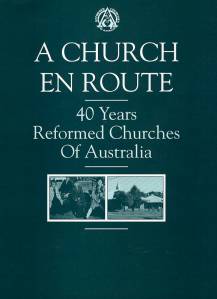
A detailed account of the development of the Reformed Churches is contained in “A CHURCH EN ROUTE” – 40 Years Of Reformed Churches Of Australia.

The Present

Today we must ask ourselves whether much of that effort and momentum has slowed to a walk, or even a crawl. We seem to be just as busy but our efforts are focussed in a different direction. Instead of forging ahead in working for the kingdom of God, we have become sidetracked and even bogged down by the issues thrown at us by an increasingly secular and antagonistic world such as divorce, promiscuity, abortion, homosexuality, same sex marriage, cancel culture and gender fluidity. To the world, the Christian teachings as espoused in the Bible are now considered to be “controversial”.

So instead of lighting fires for Christ we have become preoccupied with fighting the fires lit by Satan and his followers.

Like the church in Ephesus, have we lost the love we had at first? The solution for the Ephesians was to: “Remember therefore from where you have fallen; repent and do the works you did at first.” (ESV. Rev. 2:5)

Moving Forward By Looking Back

The pioneers who began the journey have all moved on to glory. They are gone… but not forgotten. Their thoughts, their writings and their dreams remain although perhaps relegated to a different time. I often hear it said that the world has changed. “Things are different now”. “We live in a different time”.

So did Adam, Noah, Abraham, Moses, Samuel and David. So also did the judges and the prophets. And so also did Jesus Himself. 

Yet we still look to them and learn from them. So also we can look to the early leaders of the Reformed Churches in Australia and New Zealand. We can still learn from them and follow their examples.

This then is our purpose. To resurrect the writings of the greats of the CRCA. See what they had to say and adjust our thinking and our actions to carry forward their dreams and aspirations for this, our adopted nation. We will do this by publishing a weekly blog using articles taken from the pages of Trowel and Sword – the CRCA newsletter which may be gone but not forgotten.

We invite you to join us on this journey of moving forward by looking back. Look for the masthead: Trowel and Sword Revisited.

Bert & Pieter.

We look forward to receiving feedback about any of our posts. We also encourage you to share our posts with family, friends and acquaintances; in fact anyone you think may appreciate and/or benefit from the knowledge and wisdom handed down to us from the past.   To view previous posts visit our website at www.tsrevisited.com

Leave a comment

Dr. Billy Graham Came, Preached and Went… What Now?

Dr. K. Runia. Trowel & Sword, April 1959

Preamble: After all the hopes, doubts and even scepticism expressed by various writers in T&S in the previous months leading up to the Billy Graham Crusade, Dr. Runia’s assessment and hopes make for interesting reading. No doubt many others had varying opinions of the success or otherwise of the crusades. But there can be no disputing that the crusade did have an impact. Dr. Runia’s hope was that it would be a lasting impact. After 65 years that impact has faded. Can it be rekindled? Below is a link to Dr Graham’s crusade event at the Myer Music Bowl in Melbourne. His powerful message still resonates through the ages but these days, few few seem to be listening, particularly in Australia and New Zealand.

https://www.youtube.com/watch?v=cWEf72F_d9A

Dr. Billy Graham Came, Preached and Went… What Now?

As I write this, the part of the Billy Graham crusade that was scheduled for Melbourne has been finished. In the other capitals of Australia it will go on for a while.

The attendances have been tremendous. It was reported that at the last meeting 180,000 people were present and hundreds of decisions for Christ were made.

In Melbourne in general we must say that the immediate influence of Dr. Graham’s preaching has been very, very great. As Dr. Irving Benson wrote in the Herald of March 14: “I have seen scientists, intellectuals, doctors of medicine and what are called hard-headed’ business executives, with stoical, cynical, sophisticated men and women coming penitently to Christ, all like a page out of the Gospel. That to me is the greatest feature of these three weeks. I rejoice to have seen miracles of grace. Broken homes have been reunited, parents and families have found a new quality of understanding and love”.

Well, who would not rejoice with Dr. Benson?

We all must be very grateful for the work Dr. Graham has done in Australia, and which, I am sure he will do in the other capitals too. We must be very grateful for the clear message of the Gospel of Jesus Christ, which he brought. I myself had the privilege to attend one of the meetings and the message we heard was heart strengthening indeed.

I also know that many of our Church members have been strengthened in their faith, attending one or several of these meetings. Many of them made a new, public or secret, decision for their Saviour.

Again: who would not rejoice here?

But what now? Billy Graham is going back to America, no doubt to plan new crusades in other parts of the world. We are staying here in Australia or New Zealand.

What now?

What will be the lasting fruit of this crusade in our lives, in our Churches?

I would like that all those who attended some of the meetings, asked themselves this question. What will be the lasting fruit in my life and through me in my church?

There are two possibilities. The first is a negative one the second is positive. I will mention them in this order, and in the form of what “I do not hope” and of what I do hope

I do not hope, that the main result of Dr. Billy Graham’s crusade has been, that we became so critical of our own Church life, that we do not find any good in it.

I do not hope that we make a wrong comparison, by comparing the highlight of a crusade meeting, where we are taken up in the enthusiasm of a great man, with our own ordinary Church life, where we know each other so well, where we are in the midst of the daily struggle of young migrant Churches.

You know, it is rather easy to be enthusiastic for one or a few nights, when there is nobody to irritate you by his well known faults and shortcomings!

I do not hope that our riches, received at the crusade meeting, will make us proud and induce us to look down upon others, who are so cold, so formal, so unspiritual (in our eyes)!

I do not hope that we forget, what Billy Graham himself said more than once that he could give only baby food, but that we in the Churches receive the more solid food , required for grown ups in the faith.

I do not hope…..

But I do hope that we all do what Billy Graham told us.

I do hope that we all attend the services of our own church the more faithfully.

I do hope, that we all realise the better, how rich we are in being privileged to hear the preaching of the full Gospel every Sunday.

I do hope that we all give our strength and all our support to the Church God has given us.

I do hope that we all have become very critical of ourselves and therefore filled the more with love and forbearance towards our fellow Church members.

I do hope that we all are the more prepared to be active in own Church life and that, as soon as we are called to prove our dedication to the Lord and Saviour, we are ready to come forward and join the band of workers.

I do hope that we all are burning to help to spread the Gospel flame among those around us.

In short: I do hope that we all bring into practice what Billy Graham told us to do:

Take my life and let it be, Dedicated, Lord, to Thee .

K. Runia.

We look forward to receiving feedback about any of our posts. We also encourage you to share our posts with family, friends and acquaintances; in fact anyone you think may appreciate and/or benefit from the knowledge and wisdom handed down to us from the past. To view previous posts visit our website at www.tsrevisited.com
Leave a comment

Shall We Co-operate With Dr. Billy Graham. (Question Box)

J.W. Deenick. Trowel & Sword, September 1958.

Preamble: Following on from last week’s article from Rev. van Groningen we have a second article, from Rev. J.W. Deenick regarding the visit by Dr. Graham. He is responding to a question from an unnamed subscriber who asks what to many would appear to be a reasonable question. I wonder how many of today’s pastors/ministers would answer in a similar way.

QUESTION: Dominie, it seems that some conservative christians object to the evangelistic methods of Dr. Billy Graham. What will our attitude be when he comes to Australia and New Zealand? Can there be any objection against working together with a man so sound in his message and so fruitful in his work? Should not our ministers act as counsellors on the committees for the follow-up work after the campaign? Or are we opposed to everything and everybody just for the sake of being “in the opposition”?

ANSWER: You are right, Dr. Graham is coming to Australia and New Zealand at the invitation of the National Councils of Churches in Australia and in New Zealand.

To begin with our Reformed churches are not represented in these national councils, as I believe for good reasons. I think I could formulate the main objection of our Reformed churches to the world council and to the national councils in this way. That we object to cooperation with churches that are so manifestly rejecting the authority of the Lord Jesus Christ and of the Scriptures, in their inner church life. We have separated ourselves from these churches. We did not believe that we could trust ourselves or our children to the guidance or to the pastoral care of these churches. We did not join the Presbyterian Church because we knew that we could not trust its gospel preaching in many places from many pulpits. We therefore encourage both Australians, New Zealanders and Dutchmen to join us in the Witness for the faith of the Protestant Reformation, which we believe to be the message of the bible itself.

Now Dr. Graham is coming to this part of the world in order to preach the message of salvation. We trust that he will do that, as he has generally done, in a scriptural way . We believe however that in some respects his message is not sufficiently clear and in others too limited. To give one example, we believe that the message of the sovereign grace of God should be preached more emphatically than Dr Graham does. Moreover, we believe that his activity is more revivalistic, along the lines of the Wesleys, Moody and Sunday, than Reformed in the tradition of Luther, Calvin, Hodge and Machen. In this and in other respects Dr. Graham upholds the teachings of arminianism, which we reject.

Our main problem is not what Dr. Graham preaches. We wholeheartedly agree with most of what he proclaims so powerfully. In 1954 we wrote in Trowel and Sword : “We have greatly enjoyed the reports on Dr. Graham’s campaign, most of all because it has become evident again what the world needs, even in our age  is clear and fundamental gospel preaching”.

We then continued: “but as far as we understand the Scriptures and the history of the Christian Church the deadly weak side of Dr. Graham’s crusade is the fact, that he is co-operating with people, who actually hate his message and will do their utmost to shipwreck whatever he might have achieved”.

And that is the problem. An evangelistic campaign demands follow-up work. 

“Converts” must be guided to a full understanding of the Scriptures. This follow-up work will be entrusted both in Australia and New Zealand to many sincere Christians, but also to many who cannot be trusted for one minute, and who believe nothing of what Dr. Graham preaches. It is Dr. Graham’s method to seek the follow-up workers among the so called modernists as much as among the so called evangelicals.

A Reformed follow-up worker or as he is called “counsellor” would know that in the next room his colleague would possibly deny what he affirms. Moreover, a Reformed counsellor would have to promise that he will send every “convert” back to the church to which he originally belonged in the Protestant or Catholic world. That is, I believe, a promise we can never make. We cannot advise someone else to do the thing we refused to do ourselves. We openly stated: these churches are not trustworthy. We cannot honestly say to one seeking Christian: they are good enough for you.

We do not believe, that this would be a scriptural manner of doing the follow-up work of any evangelistic campaign. But Dr. Graham insists upon this method and is excluding everybody from his counsellors who does not fully accept this way of cooperation.

Therefore we would do a greater service to both Dr. Graham and to the Christian Church by not co-operating under sincere and urging protest, than by being silent and by acquiescing in methods we do not believe to be scriptural.

J. W. Deenick

We look forward to receiving feedback about any of our posts. We also encourage you to share our posts with family, friends and acquaintances; in fact anyone you think may appreciate and/or benefit from the knowledge and wisdom handed down to us from the past. To view previous posts visit our website at www.tsrevisited.com

Leave a comment

The Billy Graham Crusade – What Shall Our Attitude Be?

Rev. G. Van Groningen. Trowel & Sword, November 1958

Preamble: Consider the context. A mere seven years previously, Calvinist migrants from the Netherlands had established the Reformed Churches of Australia as they had not been satisfied with any of the existing denominations. Now they were faced with the prospect of an evangelist from the Southern Baptists in the USA, who had been drawing huge crowds, coming to Australia. The debate centred on whether or not the Reformed Churches should participate in the coming “crusade” alongside or even in partnership with other churches which they had previously rejected. An important part of that debate centred on the teachings of Graham himself and whether they were compatible with the doctrinal standards of the fledgling Reformed Churches. In this article Rev. van Groningen, who had himself recently arrive from the USA as a missionary to serve the Reformed Church of Geelong as its minister, and who later became a Professor at RTC, looked at the cases for and against participating in what would become the largest evangelism effort in this country. For the record, the Billy Graham Crusade still holds the record for the largest one day crowd ever at Melbourne’s MCG with estimates ranging between 130,000 and 143,000 people.

The Billy Graham Crusade – What Shall Our Attitude Be?

At the outset; let us recognise that the Question – what shall our attitude be toward the Graham Crusade is an involved one. We realise this especially when we try to answer the question. For in so doing, we find that there are various possible answers.

1. We will participate in the Crusade with all our endeavours: attend pre-crusade prayer meetings and join in organisational work, assist in counselling, singing, teaching, attend work-shops etc.

2. We will co-operate; that is to say, work along in some respects.

3. We will attend the meetings occasionally, more or less as a spectator with a prayer that our presence may be of moral or spiritual aid.

4. We will not attend at all but pray for the conversion of sinners, strength for the preacher, spiritual blessings for all who hear.

5. We will ignore it completely.

6. We will oppose it and condemn it outright as detrimental to the cause of Christ.

As we seek the proper answer to our Question, we must remain tolerant of our brothers and sisters who also have struggled with this question but who arrived at a conclusion differing from our own. Let us get this straight; every TRUE Christian is deeply and vitally interested in:

a. His own spiritual welfare. Yes, by all means, he must consider this as he seeks an answer to this question.  2.Tim.2:1,

b. His neighbour’s spiritual welfare. He prays and longs that his unsaved neighbour may be brought into the fold of Jesus Christ and there be nurtured, guided, developed as a child of the Lord and thus become one with the church of Jesus Christ.  John 10:16.

c. His Lord’s special delight and love, the church. The church is precious in Jesus’ eyes. He gave His blood for it.  Acts 20:28,

d. His sovereign God’s eternal glory.  Rom.11:36.

Now then, just because every Christian is so vitally interested in these things, mentioned above, we may not close our minds or shut our eyes to the facts as they pertain to the Crusade. Preconceived notions, dreams of full churches, desires to be identified with a big movement etc., have no place in a mature Christian’s evaluations and decisions at any time; and not in face of the Crusade either.

What are some of the facts with which we are faced? Facts in favour and not in favour will be cited; thus we can weigh the evidence.

What is for participation, and/or at the least, co-operation with the Crusade? Here are some facts:

1. There are so many non-Christians and nominal church members in the world today . A real coming to life is needed. The Graham Crusade is used with varying results; let us therefore join in. (At times one hears or reads remarks to the effect that churches in America and England are “streaming full” again once the Graham Crusade has been active in a given area. That is not the case in America; true some churches have enjoyed an increased attendance, at least an increased enrolment).

2. Billy Graham is able to reach hardened sinners who would otherwise not be reached. Such a person can be persuaded to come and see the Crusade in action, but he cannot be persuaded to enter a church, or even listen to a sermon on his wireless. Numbers of incidents can be recited where this has proven true; again with varying results.

3. Billy Graham does distinguish between a Biblical and a non-Biblical message.

He will have nothing to do with the modernistic perversion of the gospel. He preaches the Lord Jesus Christ as the only hope for sinful man.

4. Billy Graham doos not in any way compromise with the liberals, though he does seek their external organisational co-operation.

5. If a church does not in any way work along with the Crusade, no references will be made to that church. Thus a church would miss out on receiving enquirers and converts who sorely need the further ministrations of the means of grace and who would add to the membership.

6. The ministers of those churches which co-operate preach more evangelistically, directly, personally once they have worked along with the Crusade.

7. The Crusade is a means of uniting many churches and many Christians: of various confessions into one mighty praying force for the conversion of sinners. Surely no one would want to miss out on that unified prayer activity.

8. Workers who serve as choir singers, ushers and especially the counsellors get a great personal blessing.

9. The ministers who attend the workshops are greatly stimulated in their task of active evangelism.

10. God in His providence is bringing the Graham Crusade to this part of the world. Dare we ignore or oppose God’s providential provisions for the preaching of the gospel as it is done in the Graham Crusade? (But, did anyone speak this way when Oral Roberts and his band moved into Melbourne and other cities? God in His providence placed the Presbyterian, Methodist, Baptist and Anglican churches here long ago. Yet we are convinced we should not be identified with these “providentially present” denominations and rightly so). 

Undoubtedly one can add to this lineup of arguments favouring participation of some kind in the Crusade. But now, is there anything to be said which might lead one to view the Crusade in an unfavourable light? Here are some facts:

1. The results of the Crusade up till now have been varied. Much superficiality has come to light. There are those converted, and they are many, whose zeal is short lived. They gave every evidence of a true conversion; seemed to taste the joys of spiritual awakening and life. But they dropped away soon after the Crusade moved away. What of these? Heb. 6:4-6 tells us a frightening truth. Revivalism has been and still is a means of unnecessarily exposing many people to this great threat of the impossibility of repentance and renewal. 

2. The superficiality of the Crusade comes to light in the lives of many other folk who became or who were Christians before. These folk, once having enjoyed the Crusade meetings are disappointed and often deeply critical of the church and its work. Graham’s sermons are considered the proper regular diet, which he himself denies. The regular church services are too dead, formal: people long for the thrill and drama of a large mass meeting with a prepared psychological atmosphere produced by music, choir, manner of speech etc. Solid, soul building, doctrinal instruction in Catechism and preaching is strongly frowned upon if not openly rejected. These folk also become critical of and often retard their own church’s mission activity.

3. The Scriptural teaching regarding the church is sadly neglected. Though Graham wishes to channel the converts into the church, the entire Crusade is pervaded by a pietistic, fundamentalistic atmosphere which has been particularly harmful to the organised church of Jesus Christ. The church does not receive its proper due. Though churches invite, participate and co-operate, the Crusade as such is an independent organisation. It does not come forth directly from the church. The Crusade thus encourages an individualistic or organisational preaching of the gospel which results in the church’s increased lack of responsibility for and execution of its witnessing task. Then too, it is happening in various places that Graham organisations are arising, meeting separately which are actually considered a substitute for the church. Does not anyone who takes Paul’s letter to the Ephesians seriously, especially Chapter 2, hesitate to join in a movement which does not meet up to the Scriptural teaching of the church?

4.The Crusade hampers, rather than aids, a truly Biblical program of evangelism. Jesus spoke to multitudes, but his meetings were entirely different from the present day organised mass meetings. And Christ knew how to conduct such a meeting; read how He did that in John 6. The altar call, the pressing for public show of an intimately personal, spiritual decision is foreign to Scripture. It is true, the Graham Crusade endeavours to do the correct thing in making personal contacts after the meeting and to have these continue; but these are overshadowed by the psychology of the “mass meeting”. Peter gives us the Biblical example – he went to the home of Cornelius and there dealt with him in the living situation in which Cornelius lived day by day. Paul entered into the Jailor’s home and evangelised. Phillip made a fruitful personal contact with the Eunich. “What” you ask, “no meetings then?” Yes, meetings are Biblical. Notice what Paul did, e.g., Acts 18. He first went to the established customary place of worship, the 0.T. church. From there he went into the homes.

5.The history of revivalism in the U.S. has a sorry tale to tell us. With each wave of revivalism there was a seeming upsurge in spirituality. But – viewed from a further perspective, after each wave of revivalism, about 25 years later, the churches were worse off than before the revival; Biblical theology was watered down even more than before; rampant individualism was more deeply entrenched than ever. Read the history of the U.S. See what happened after a Charles Finney, Billy Sunday, D.L. Moody swept across the nation!

6. Australia and New Zealand have been witnessing too many hit and run evangelists in the past. There is an anti “Evangelists” mood prevalent. The Crusade will quite likely drive many folk to a more hardened resistance against the gospel, which will make it the more difficult to win such a person if and when a more Biblical method is employed.

7.An amazing confusion will be a most logical result from the mixing of our Reformed witness with the fundamentalistic Arminian teaching and method of the Crusade. A few clarifying statements are in order: 

a). Though Graham is utterly and genuinely sincere in his attempt to keep out emotionalism and to present a simple Biblical gospel message, the co-workers all too often negate Graham’s endeavours. Too many of Graham’s teams are employing emotional techniques and are extremely Arminian in their preaching and teaching.

b). Though Graham wishes to be as true to the Scriptures as possible, he is still a product of his training. Graham is growing, developing in the truth of the Scriptures; for that we praise God. But at present Graham’s preaching is cast in the frame of an over emphasis on the will of man. At a press conference in New York, Graham stated, “Primarily, however, when a person comes to Christ it is his will – he is saying: I willreceive Him. I will follow Him. I will serve Him.” The Reformed witness says, “no man cometh unto the Father except he be drawn” and “for by grace ye are saved through faith and that not of yourself, it is the gift of God; yield then, your heart, your mind and your will, your entire personality as a whole to this sovereignly gracious God.

8 .The problem of referring converts to any church of their choice I need not deal with. I wholly agree with what Rev. J. Deenik wrote in the September  issue of “Trowel and Sword”,

The Crusade has been placed in the balance. How are we to judge as to what our attitude should be?

We can ask: how is tho greater glory brought to God? Some say, “by the conversion of sinners, using whatever methods are at our disposal”.  Others say, “By being a true, loyal church of Christ, avoiding all that hinders, detracts from, and or that brings unnecessary disrepute to the gospel and to the church”.

I personally am convinced that I must give the latter answer. But be sure to realise this: if the church is true and loyal to its Lord, not only will the church grow and develop, avoid unnecessary disrepute for itself and the gospel committed to it, but sinners also will be brought to conversion. The point is this: let us be a true church. Let us take our Christ-given mandate seriously to go forth and evangelise. From within the established, consecrated church the program of evangelism is to issue forth. Under the impetus and supervision of the church, the members must carry the witness to their neighbours. Do YOU want a church full? Do YOU want your neighbour to be saved? Then YOU as a church member go to him, talk to him, take him along to YOUR CHURCH and to YOUR CHURCH’S MEETINGS. Then we will have numerous conversions, Then the church will grow, then we will make an impact on our communal, national life. Biblical evangelism does not ask another to witness to my sinful unsaved reighbour, it demands that I do it.

If we would get busy and be a CHURCH we would have little if any NEED for the Crusade. Indeed, if we would truly be a church, we would not even have the TIME to join the Crusade.

The Crusade is coming.

What shall we do?

My position is becoming increasingly a strong conviction in my heart. May I add that past experiences play a part also. As a youth at home in California, and as a soldier in the army working in spare time with the Chaplain, I have attended and participated in many “Youth for Christ” and various other revival type meetings. Having been somewhat enamoured by these for a while, actual participation did give a rather unwholesome reaction. Today I would urge no one, if only for his spiritual wellbeing, to join in fully and actively in such ventures. Likewise, my attendance at the Graham meetings and hearing him often over the wireless and T.V. in the U.S. all influence my position.

My position is this: I cannot recommend participation or co-operation with the Crusade. I do not feel conscience free to again participate in a movement the like of which I have been deeply disappointed with before. I must spend my time and energy in the Reformed church, endeavouring to awaken it increasingly and guiding it in the direction of Biblically prescribed means of growth, development, zeal for and method of evangelism.

This does not mean I will ignore the Crusade. I may visit once or even twice. That, for one thing, will help me to remain alive to what the Crusade is. I will gladly work with any convert or enquirer that is referred to our church. I will pray for Billy Graham as a preachor and for the preaching of the gospel. I will pray the Lord to use the Crusade as He sees fit. But praying this, I still cannot feel free to join and strengthen the Crusade as it now is.

G. Van Groningen.

We look forward to receiving feedback about any of our posts. We also encourage you to share our posts with family, friends and acquaintances; in fact anyone you think may appreciate and/or benefit from the knowledge and wisdom handed down to us from the past. To view previous posts visit our website at www.tsrevisited.com

Leave a comment

The Telly: A Spiritual Health Hazard

Rev. Raymond O. Zorn. Trowel & Sword, June 1996

Preamble: Just under thirty years ago when this article was written, life was so much simpler than it is today. We only had the “evils of television” to worry about. Today we also have the internet, mobile phones and social media platforms multiplying rapidly. So while this article may seem somewhat outdated, the issues and problems that it raises are equally relevant when applied to today’s technologies. In fact, Prof. Zorn could not have imagined the extent to which technology has take over our lives, nor the effect it has had on our culture. Add to that the rapid development of artificial intelligence and one can only wonder, where (or when) will it all end?

The Telly: A Spiritual Health Hazard

The shortcomings of television have, over the years, been well-documented. That it encourages a passive, couch-potato mentality, treats subjects superficially, portrays a false sense of reality, is uncritically misused by the hour as a children’s baby-sitter and, worst of all, is too easily enjoyed even by adults whose critical perceptions have in the meantime all but disappeared, is virtually beyond dispute.

In addition to the above “health” hazards, however, TV too easily escapes detection as a spiritual health hazard for Christians. This is not to say that all TV viewing should be banned, which has been an extremist position adopted by some in the past but which has proved untenable – unless one refuses to have a TV set in the home and is able to keep the children from watching it on sets in the homes of other children the neighbourhood.

It should be recognised that the issue about watching TV is not just whether, instead of being a servant, it becomes a master. Nor is it that there is nothing worthwhile to watch on TV. In some instances, it can even serve a useful purpose, and these different levels of usefulness should be acknowledged and appreciated.

One useful purpose would be the viewing of news. While, admittedly, that offered by the local stations is often superficial and parochial (compare it for example with world news), getting the visible picture of TV is graphic if not powerful. Think of the plight of war victims, refugees, etc., which in being publicised by TV brought the refugees much needed relief aid.

Another level of usefulness would be the educational realm. “Sesame Street” for children has limitations with which parents by now are familiar. But there are travelogues, animal and nature studies, gardening tips, current affairs, etc., which increase the knowledge and understanding of the viewer.

A popular level of TV use is for sports. Those who like to be entertained in this way have a large variety from which they may make regular selections. The viewing of some forms of sports is perhaps questionable. Is the deliberate mayhem of boxing a sport? Do the frequent violent smashes which occur in auto racing make it a good sport to watch? Should the gambling associated with horse and dog racing be encouraged, even if only by viewing it on TV? However, sports-viewing is usually only a hazard when too much time is given to watching it. Like everything else in life, the exercise of self-control and moderation is necessary, especially in matters of entertainment and recreational pursuits.

Can the same be said for other forms of entertainment on TV? Here is where factors arise that need serious consideration. Not just the questionable pop psychology of some talk-back shows like “Oprah Winfrey” or the greed-promoting ones like “Sale of the Century”, even if the feelings of greed can only be satisfied vicariously. Matters are even more serious when it comes to virtually all “sit-coms”, for these shows uniformly present and promote a lifestyle that is inimical to that which should be the Christian’s.

The apostle Paul wrote, “Do not be conformed to this world…” (Rom.12:2). If his original readers were in need of this warning, how much more this is true of the viewers of sit-coms. In many of these programs blasphemy (“My God” is one of the more milder but frequent epithets) is habitually used, vulgarity (think of the “Golden Girls” who one would think should know better) is promoted under the guise of comedy, immorality is worked out in fine detail (“L.A. Law” was particularly lawless in this regard, with its adultery, homosexuality, and shady ethics at the top of the list). The attack upon the family and its values is also a favourite target, a typical sit-com being, “Married With Children”, with its portrayal of father as a brainless oaf (or is it victim, one is never quite sure?), the wife as a brazen hussy, and the children as unruly, cheeky upstarts sadly in need of discipline.

More also needs to be said about a lifestyle in sit-coms that is commonly but unrealistically lavish. Money never seems to be an object of thrift nor is frugality even considered, let alone encouraged, as a virtue. Religion of course gets no mention, or where in rare cases it does, it is only the object of a joke or ridicule. Gambling, drinking, adultery, homosexuality, etc., seem to be part and parcel of most plots. Pervading the whole atmosphere of the presentation is humanism, with its teaching of man as basically good, independent and autonomous, free to do his own thing and not really in need of the restraints of discipline.

Oh, but someone may say, why be so critical? It’s only entertainment and therefore not to be taken seriously. Would that this were the case. Just one example proves the contrary, namely, marital break-ups, which were rare in the church a generation ago but which have become as much a problem in the church as in the world. The observation of the German philosopher, Feuerbach, aptly applies, “Man ist was man isst” (literally, “One is what one eats.”). In similar vein the English poet, Alexander Pope, pointed out, “Vice is a monster of so frightful mien, As to be hated needs but to be seen; Yet seen too oft, familiar with her face, We first endure, then pity, then embrace” (from An Essay on Man).

It’s the old story of salt, instead of fulfilling its purpose of being salty, losing its saltiness and becoming worthless, as our Lord Himself reminds us (Matt.5:13). What our society so desperately needs today are Christians whose pattern of living is not shaped by the artificial and harmful reality of TV sit-coms but by the morality divinely prescribed in the Ten Commandments. Scripture warns, “Don’t be conformed”, because it’s an ever-present danger, and never more so than with the influential pressures of TV upon the lives of God’s people.

Are sit-coms without any merit whatsoever? One could hardly say this without first having sat through most if not all of them. Moreover, certain detective series (“Poirot”), and drama (“Shadowlands”), etc., might in a sense be classified with sit-coms, though in the former, the redress of wrong more than anything else is to the fore, while in the latter a true autobiographical story is portrayed. However, discerning viewing here is also required.

A good principle to be followed when watching sit-coms (whose specific aim is to depict, in some measure at least, a true to life situation) is, what if any is the moral basis of this program? Does it foster a morality in keeping with Christian principles, and if not, does make clear what the consequences are when these principles are violated? Or is its basis actually anti-Christian and the goals it portrays intended to magnify the humanistic spirit of arrogantly independent, seemingly self-sufficient man? If the latter is the case, such sit-coms should be avoided, not only for the sake of one’s Christian testimony, but because such are clearly a spiritual health hazard, not only to adults, but even more so to children and young people.

The secular and pluralistic spirit of our society has put TV beyond reformation in harmony with Christian standards, unless the Lord in his mercy sends revival to our society. Since this is true, it is also true that Scripture exhorts Christians not be conformed to the pattern of this world, not only for their spiritual health, but also that by their uncompromising lifestyle, they may be means that God is pleased to use for the conversion and transformation of increasing numbers in society.

Rev. Raymond O Zorn, Emeritus Principal and Professor, RTC. Geelong.

We look forward to receiving feedback about any of our posts. We also encourage you to share our posts with family, friends and acquaintances; in fact anyone you think may appreciate and/or benefit from the knowledge and wisdom handed down to us from the past. To view previous posts visit our website at www.tsrevisited.com

Leave a comment

What Does Our Church Teach?

C. Schaveling. Trowel & Sword, June/July 1959.

Preamble: This article was originally published across two editions as shown above. It begins with a brief introduction, presumably written by Dr. K. Runia, in which he invites readers to share their copies of Trowel & Sword to people who may be interested in learning more about the teachings of the Reformed Churches. A much more comprehensive summary of the Christian Reformed Faith was also written by Dr. Runia in the Dutch language and later translated into English by Rev. Martin Geluk for use in Catechism classes. It is titled, “A Summary of the Reformed faith”.This booklet was published by the Reformed Church Publishing House in Geelong and printed by List Print which was operated by Rev. John Piening. We at TSR have reproduced this booklet to make it available to any church interested in using it for current catechism classes; at no cost for an electronic version or for the cost of postage for hard copies. In the process, we have changed the scripture quotes from RSV to NIV.

What Does Our Church Teach?

(This article was prepared by Mr. C. Schaveling of South Australia. The reason was that so very often we are asked: “What does your church teach?”, and so very often we have much difficulty in formulating this teaching. In order to give some help he collected the following items from the February, March and April 1959 issues of the Family Altar, published by the Back to God Hour organisation of the Christian Reformed Church. If you have friends who are genuinely interested in our Churches, you might pass this, and the next copy of “Trowel and Sword” on to them. Editor.)

Sooner or later, if we don’t believe in isolationism, we will be confronted with the question; What does your church stand for, is it an all Dutch concern? What does it teach, and why does it differ from other denominations?

Are you able to give a satisfying and convincing answer?

Are you propagating and supporting the Back to God Hour? Are you circulating your “Trowel and Sword” and other literature?

Well, here is your golden opportunity, let this magazine be read by as many as are willing to read it; don’t think, they won’t, because they are eager to find out the”TRUTH”; John 14:16.

Here then follows condensed what the Reformed Church teaches.

THE SAVIOUR

The Reformed Church teaches that Jesus Christ, the Saviour, is the Son of God, and equal to the Father in all things; that he is also the son of the virgin Mary and became like unto all men in all things, sin excepted; that he satisfied the demands of the divine law by his life, passion, and death; that he arose bodily from the dead, ascended to glory, and is now our intercessor with the Father; and that he will return visibly at the last day to judge the living and the dead. John 14:9; Gal. 3:13; Matt, 1:18-25; Heb. 2:17; Heb. 4:15; Rom, 4:25; Acts 1:9-11; 1 John 2:1; Acts 10:42.

THE ATONEMENT 

The Church teaches that the justice of God required that the demands of the law be met; that Jesus Christ as a substitute atoned for the sin of mankind and wrought an eternal redemption for man; and that the satisfaction of Christ applies to those whom God in His sovereign love has chosen as His people and secures their salvation.

The Reformed Church repudiates the doctrine which holds that the atonement is universal and that man’s actual redemption depends on his own free choice. Is. 53:6; John 10:11,15; Matt. 1:21 Acts 20:28; Eph. 5:25-27.

THE GOSPEL 

The Church teaches that the gospel is the revelation of that which God in Christ Jesus has done and will do for the salvation of sinners and to His glory, and that to all who hear the gospel God offers salvation in the way of faith and repentance. Mark 1:15; Mark 16:15; John 3:16; Rom. 1:16; Acts 15:7.

REGENERATION 

The Church teaches that regeneration consists in the implanting of the new spiritual life in man by God through the Holy Spirit; that this radical change is not a gradual process, but is completed in a moment of time; that the in man evidences of this change are seen in a new life; and that without regeneration it is not possible to enter the kingdom of God. Ezek. 11:19; John 3:3; Cor. 2:14; Eph. 1:18; Col. 3:10, Gal. 6:15.

CONVERSION 

The Church teaches that conversion is not a mere reformation of habits, but change wrought by God in which the to a regenerated man consciously turns

him in repentance and faith; that repentance is a sincere sorrow for and an acknowledgement of sin with a trustful appeal to God for forgiveness and a resultant change in life; and that it is a condition of the heart without which no man can hope to be saved, Acts 17:30; Joel 2:12,13; Is. 55:6,7; Luke 13:5; Acts 3:19; Acts 2:38; 2 Cor. 7:9,10.

FAITH 

The Church teaches that faith is the act of the soul by which the convicted sinner receives the truth of the gospel, relies upon the promises of God, and thus embraces Jesus Christ with all his merits; that such faith is not a personal achievement but rather the result of the work of the Holy Spirit in the sinner’s heart; and that without it no salvation is possible. Eph. 2:8; Acts 10:43; Acts 16:31; Gal. 2:16; John 3:18.

JUSTIFICATION 

The Church teaches that on the basis of the finished work of the Lord Jesus Christ God grants forgiveness of sins and declares the sinner righteous before him; that God imputes Christ’s righteousness freely of his grace and not because of any merit of man; and that this righteousness becomes the possession of all who believe in Christ with true faith.  Eph. 1:17; Rom. 3:24; Rom. 5:1; Rom. 3:28; Acts 10:43; Gal. 2:16.

SANCTIFICATION

The Church teaches that God, having renewed the sinner by the operation of the Holy Spirit, enables him to live a godly life; that all christians manifest the fruit of their faith in good works; and that, though sanctification is progressive, perfection is not attained until man enters glory. 2 Cor. 5:17; Gal. 5:24; 2 Cor. 7:1; James 2:22; Gal 5:6; James 3:2; Rom. 7:7-26; Philip. 3:12-14; 1 John 1:8.

DIVINE ELECTION 

The Church teaches that God in his eternal plan for all creatures has foreordained all things that come to pass; that in his sovereign love and according to his good pleasure he has chosen in Christ out of the whole human race a people unto eternal salvation; that from this election proceed faith and all the gifts of salvation; and that the ground for this election is not anything in man which would merit for him any favour but solely the good pleasure of God. Is. 46:9,10; Eph, 1:4; Acts 13:48; Psalm 33:11; Eph. 1:11; 2 Tim. 1:9.

ETERNAL SECURITY 

The Church teaches that by virtue of their election, the substitutionary atonement of Christ, and his intercession for them, the salvation of God’s people is assured; that God will not suffer those who are joined to Christ in true faith to totally fall away from faith and grace; and that by reason of the continuous abiding of the Holy Spirit the believers will persevere in the way of salvation to the end. John 10:28,29; Heb. 7:25; Rom. 11:29; Philip. 1:6; 2 Thess. 3:3;  2 Tim, 1:12.

THE CHURCH 

The Reformed Church teaches that there is an invisible Church, which consists of all true believers; that Jesus Christ is the Head and King of the Church; that this Church is one; and that this Church has been from the beginning of this world, and will be unto the end thereof.

The Reformed Church also believes that this invisible Church becomes visible in the fellowship of those who profess the true religion together with their children; and that it is the duty of every Christian to join and support that section of the visible Church which stands for the pure preaching of the Word, the Scriptural administration of the Sacraments; and the elimination of those from its membership who are not sound in doctrine or lead offensive lives. Eph. 1:22,23; Tim, 3:15; Col. 1:18; 1 Cor. 12:13; Matt, 16:18; John 8:32,33; Acts 2:42; Matt. 18:18,

BAPTISM 

The Church teaches that Baptism, even as circumcision in the Old Testament days, is a sign and seal of the Covenant of Grace; that children, as well as their believing parents, are included in that Covenant and hence are entitled to that Sacrament; and that God in baptism seals his promises of the forgiveness of sins and eternal life to those who profess their faith in Jesus Christ, and to their children. Gen. 17:7; Acts 2:39; Matt, 28:19; Matt, 19:14; Col. 2:11,12; Rom. 1:11.

THE LORD’S SUPPER 

The Church teaches that the bread and wine in the Lord’s Supper represent the body and blood of the Lord Jesus Christ, broken and shed upon the cross; that by these visible signs and seals of his love the believer is assured of the promises and blessings of God’s Covenant; and that through the proper observance of his ordinance of Christ the faithful believer grows in the grace and knowledge of his Saviour. Cor, 10:16;  Matt, 26:28;  Mark 14:22-25; 1 Cor. 11:23-29.

THE LAW

The Church teaches that the Law of God is the divine revelation of his will for all rational creatures; that it serves to bring man under the conviction of sin and to lead him to Christ; that in the light of the law man learns more and more to know his sinful nature: and that it is the rule of life for believers in showing their gratitude to God for their salvation. Rom, 3:20; 1 John 5:3; Psalm 19:7,8; Gal. 3:24; James 2:10. 

THE CHRISTIAN LIFE 

The Church teaches that, having been implanted into Christ, the child of God delights in bringing forth fruits of thankfulness; that he shows his love for God by doing good works, namely, such as are done from true faith, according to the Law of God, and to his glory; that he should manifest a zeal for the honour of his God by recognising him in every sphere and relationship of life; and that he should labor ceaselessly for the propagation of the gospel and the evangelisation of the world until the kingdom of God shall embrace the whole of God’s creation. Matt. 7:17; Eph. 2:10; 1 Cor, 10:21; Matt, 5:16; Rom, 11:36; Matt, 28:19,20.

PRAYER

The Church teaches that prayer is the chief part of thankfulness which God requires of his children; and that the prayer of faith has God’s assured promises of acceptance and answer because of the merits of Jesus Christ, in whose name alone all men should pray. Psalm 50:14; James 5:16; John 14:13; Matt. 7:7; 1 John 5:14; Is. 65:24; Matt. 21:22,

DEATH 

The Church teaches that physical death is God’s judgment upon man’s sin; that for the Christian the sting of death has been removed through his deliverance from sin and its punishment; and that for the Christian death now is the means whereby God delivers him from the body of death and prepares him for Entrance into glory. Rom, 6:23; John 11:25,26; Rom, 5:12; Philip. 1:23; 1 Cor. 15:55-57.

THE INTERMEDIATE STATE 

The Church teaches that the believers enjoy a conscious life in communion with God and with Jesus Christ immediately after death; that sinners as well as saints continue to exist for ever; and that man’s eternal state is irrevocably fixed at death and no opportunity for repentance is possible beyond the grave. Luke 23:43; 2 Cor. 5:8; Rom, 5:12; Philip 1:23; 1 Cor. 15:55-57.

THE RESURRECTION AND THE LAST JUDGMENT 

The Church teaches that the body which in death was separated from the soul, will be raised on the Last Day and will be reunited with the soul; that the believers will be judged by Jesus Christ according to what they have done, whether it be good or evil; and that all the righteous will enjoy the perfect bliss of glory forever while all the ungodly will be sent to eternal condemnation. John 5:28,29; Matt, 25:31-46; Rev. 20:12-15; Gal. 6:7,8; Rev. 21:3,4.

APPENDAGE

CHRISTIAN EDUCATION 

The Reformed Church maintains that the education of children is the task of parents; that it is proper for the parents to organise Christian elementary and high schools for the purpose of assisting them in bringing up their children in the nurture and admonition of the Lord; that parents owe it to themselves, their children, and their God to cooperate in activities undertaken for the Christian education and training of children and young people; and that the Church should urge the opening of private Christian schools and lend such moral and financial support as may be required and is possible for the Church to give.

LIFE OF SEPARATION

The Reformed Church holds that Christians should lead a life of spiritual separation from the world; that they should avoid all fellowship with institutions and organisations that are anti-Christian in character or are guilty of un-christian practices; and that they should manifest in their lives an aversion to participation in activities and amusements which injure their spiritual and moral well-being.

CHURCH GOVERNMENT 

The Reformed Church maintains that Christ is the head of the Church and the source of all its authority; that Christ exercises his authority by means of the Word; that Christ as King has endowed his Church with power to carry out the work which he has entrusted to it; and that the ruling power in the Church sides primarily in the local consistory which consists of elders chosen by the congregation and, together with other consistories, deal in major assemblies, classis and synod, with matters of doctrine, church government, discipline, and all that pertains to the preservation of unity and good order in the Church of Jesus Christ.

C Schaveling

We look forward to receiving feedback about any of our posts. We also encourage you to share our posts with family, friends and acquaintances; in fact anyone you think may appreciate and/or benefit from the knowledge and wisdom handed down to us from the past. To view previous posts visit our website at www.tsrevisited.com

Please leave an expression of interest in the comments box if you or your church is interested in the above mentioned, “A Summary of the Reformed Faith”.

Leave a comment