Once Again – The Sunday school

Mrs M.H. MacFarlane, Trowel & Sword, May 1969

Preamble: Following on from last week’s article by Prof. K. Runia we have the following contribution from Mrs. M.H. MacFarlane who was obviously passionate about Sunday Schools in the Reformed Churches. In a very positive contribution to the debate Mrs. Macfarlane put forward a number of suggestions which she felt would greatly enhance the role of Sunday Schools in the Reformed Churches; her focus being on improving the skills of teachers and the curriculum. At the time, the Christian Schools movement was still in its infancy. With the explosion of Christian Schools around the country today one would expect that curriculum and teaching in Sunday Schools would be of a much higher quality than in the past. Is this the case, or has the advent of Christian Schools made church based Sunday Schools obsolete? What do you think?

Once Again – The Sunday School

In his realistic article on The Sunday School, Dr. Runia gave us 4 points to consider in our approach to this work. He admits himself that he gave us more problems than solutions. I would like to offer a few practical solutions gained from experience during association with Australian Sunday Schools (commencing with child No.1, 22 years ago, and proceeding through many and varied Sunday Schools over the years to child No.6.)

The Sunday School, alas, has been a very neglected part of Reformed Church life. The whole problem demands re-thinking by our Churches of what the Sunday School is, and what it should be.

For too long our Sunday Schools have been looked upon as just glorified “baby-sit” to keep the little ones happy during Church, or to provide an extra half-hour after Church. In fact there are still many of our churches that only provide this half-hour where a short Bible Story is READ (heinous crime), a verse given to learn, and a pamphlet thrust into the little hands to take home. These so-called “Sunday Schools” usually only cater for the child up to 9 years old – just the age when you can really begin to teach him something in Sunday School – and are run by a Sunday School Committee of which the Minister often is not even a member, he sometimes having no association whatsoever with the S.S.

In point No. 1, Dr. Runia discusses the nature of our S.S. Should it be instructional, for our own children, or evangelistic? I ask; should it not be both? Many families outside the church life can be introduced to our church through their children attending the Sunday School. And surely an hour a week to learn of their Saviour’s love with the application geared especially to their understanding, is needed also by our own church children.

So, to have a good Sunday School we must have (1) the children to teach – both outsiders and our own; (2) sufficient time in which to teach them – at least an hour, preferably a little longer; (3) dedicated teaching staff; and (4) the right teaching material.

To deal now with point No.3 – Teachers. It is amazing how quickly a dedicated teacher can learn also to be a qualified teacher. And, having once attended a training session or even read a good book on Sunday School Teaching, a rather lukewarm teacher can become a most enthusiastic disciple.

The main qualification for Sunday School Teacher is to feel that the work he or she does is IMPORTANT. Important enough not to mind missing that “nice quiet Sunday” with cups of coffee with friends… important enough not to mind giving over one or two whole evenings each week to preparing for the Sunday School lessons. Important enough to give up time to think about the individual class members and their problems, even to visiting each family a few times during the year, and arranging class outings some Saturday afternoons. Important enough to read books on Sunday School Teaching and attend conferences and Training Days.

If a teacher is dedicated to his task – teaching his children the living word of God to the point that they (the children) also want to commit their lives to this living Saviour, then he will find no trouble in training himself to BE a qualified Sunday School teacher. And don’t tell me we don’t have such dedication among our Church members! I’ve seen them, and know they are there.

First, all Sunday School Supervisors should buy a few basic books for their teachers to read. An old fashioned book of Spurgeon “Leading Little Ones to Christ” gives the basic idea of what they are there for… Another excellent book on S/S teaching which everyone should study is Sunday School Teaching, by J. Reginald Hill (C.S.S.M. Press), This could provide the basis for a Sunday School Teacher Study Group led by the Minister, which could be part of the life of the Church, say twice a year. (I think the time mentioned by Dr. Runia “every two or three years” is far too seldom.)

There are also films available from Fact and Faith Films, Carlton, giving a wonderful insight into practical S/S teaching. These films are not too expensive, and could be shown in a city centre where several Sunday Schools could participate in their instruction.

The CSSM, a most experienced group of children’s workers, will also conduct a S/S Teacher’s Conference Day, 1f they are invited, We had one at Moe, where we learnt so much, that we all went home eager and anxious to put everything into practice at once. The CSSM Missioner John Lane, told me he would be glad to conduct Sunday School Teacher’s Leadership Conferences, when and where we would like to arrange them. Points discussed during these Training Periods are “Proper preparation of the lesson;” “How to present truly the AIM of the lesson, “How to tell the story so the children really understand it,’ “Singing in Sunday School,’ “Handwork,” “Project Work,’ etc. Also understanding the child, and knowing just how much each age group can cope with.

And so we come to point No. 4 CURRICULUM. This has been difficult for all our Sunday Schools here. For obvious reasons we can’t use material from Holland, while the American material is not always geared to the Australian setting, and is also rather expensive. Some material is considered too Pentecostal, etc. etc.

In Moe we use the S/S material put out by Mission Publications of Australia, printed in Sydney. It was introduced to me by Rev. Hanscamp and we find it excellent. This is Bible-based S/S teaching, originally prepared for Aboriginal Missionary Sunday Schools, but now being used more and more by city and country S/S’s of all evangelical denominations. It covers the whole Bible over a period of 7 years, and alternates Old and New Testament material. It is well graded into 5 age-groups from 3 years to 15 plus, and attractively presented in colour. It is also very inexpensive, costing only 10c. per child per quarter (13 weeks).

The very best thing about it is the Teacher’s Handbook, which is really a Teacher’s Training Course in itself. This costs only 50c. per quarter, and sets out the background material, Bible verses to study, AIM (or message) of each story, with interesting remarks on how to present the story, how to gain the child’s interest, visual aids (given free) etc. If a local Sunday School wanted to provide a monthly Teacher’s Training evening, the basis of teaching for the month’s lessons could be studied from this book, with much benefit to all concerned. It is an invaluable help to the young and inexperienced teacher, and I cannot recommend it highly enough . M.P.A., 46 Adina Av. La Perouse, N.S.W. 2036; would be glad to send sample material to anyone interested, or I can give any further information.

Lastly Dr. Runia mentions the role of the parents, and this too is a vital part of Sunday School work. As I mentioned earlier, if the Sunday School teacher can become a friend to his or her children and also become known to their parents – the benefits derived by the children from their Sunday School hour, can be carried over into their home life during the week.

One of the Sunday School teachers in the Presbyterian Church used to have the children of her class around to tea at her home once every month. To get this sort of personal contact into the Sunday School, the classes should be kept as small as possible.

Finally, it would be helpful for Sunday School Teachers – and especially Supervisors and Ministers – to read the excellent book put out by the Dee Why Christian Schools Association, prepared mainly for Saturday Morning Schools, but which applies also in its ideals and insights, to the Sunday School – as it should be.

(Mrs.) DEL MACFARLANE.

This poem is from the latest M.P.A. TEACHER publication:

DEFEATED

I meant to study all the week
And very carefully prepare.
I meant to kneel yes, every day
And bear each pupil up in prayer.
But I was weary, and I found
So many things that I must do

Important things that could not wait
The week was gone before I knew.
I meant to visit several homes,
And mail some cards to absentees
To let them know that they were missed;
For such a word is sure to please,
And often brings them quickly back.
But somehow every day went by,
And not a single card I sent.
And now I ask, "Why didn't I?"
So this morning when I rose
I tried to study while I ate
I briefly read my teacher's book
And hurried out, five minutes late.
I found them singing, and I dropped
Breathless, ashamed into my seat;
For I intended to be there
In time the earliest child to greet.
Time for the lessons, and a group
of eager voices beg their turn
To quote by heart the memory verse
Which I, alas, forgot to learn.
And so I stumbled through the hour,
And built with stubble, hay and wood,
Instead of gold and precious stone
And silver, as His servants should.
"Go feed my lambs" was His command
And shall I hope for them to live
On little morsels such as this,
When mighty feasts are mine to give?
Forgive me, Lord, that I should treat
Thy Word in such a shameful way,
And may I never stand again
Defeated, as I've done today.
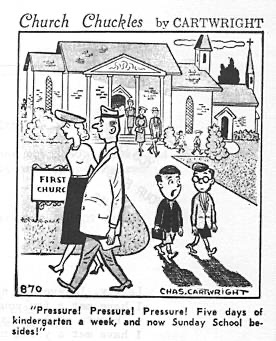
Our Sunday Schools

Prof. K. Runia, Jan/Feb 1969

Preamble: In this article Prof. Runia takes a brief look firstly at the history of Sunday Schools and the role they were originally intended to play in society, followed by an assessment of Sunday Schools in the Reformed Churches in Australia and whether they achieve their intended goals. It would be fair to say that nothing much has changed in the ensuing years. In his own words, Prof. Runia asks more questions than he answers. One question which we may ask is, “Is there still a place for Sunday schools today, or is there a better way to teach our children about God, Christian beliefs and practices?” It would appear that Prof. Runia’s purpose in asking his questions was to initiate a debate on this topic. Perhaps now, 55 years later, it is time to reach some conclusions.

Our Sunday Schools

Fairly soon our Sunday Schools will start again. Perhaps they have already started in your congregation when you read this article.

In a way the Sunday School is a rather recent phenomenon in the life of the Christian Church. It started in the 18th century in England, when Robert Raikes began the movement in Gloucester. Originally it was a kind of slum-clearance project. Raikes saw how many children in his neighbourhood were completely neglected educationally and decided to do something about it. He opened a school for them on Sunday, for the teaching of Scripture, reading and other elementary subjects.

For many years in the 19th century the churches themselves opposed the new idea.

“Sunday school pupils often learned to read in Sunday schools, because public schools were rare at the time; and this was deemed a desecration of the Sabbath. Others felt that Sunday school would interfere with family religious training. Some opposed it because they were afraid that it would take the Bible out of the public school”. It was not until the mid-1800’s that many churches became reconciled to the Sunday school. Since that time it has become one of the regular fixtures in church life.

In recent years, however, it has increasingly been subjected to CRITICISM. Some recent authors are rather gloomy about its future, and this is not without reason. For one thing, in most churches attendance is down, While the total population of our country is climbing all the time, Sunday school attendance is shrinking. In a recent article in an American journal it is stated that “in a cross-section of 20 denominations only three kept pace with U.S. population growth”. Even the aggressive church-planting Assemblies of God (Pentecostal) were only able to add 5000 pupils to their rolls. Another problem is the generally disappointing results of Sunday school education. I quote again from the above mentioned magazine. “The Southern Baptists recently gave a rather simple 34-question test to 16000 people in 250 churches. Questions like ‘What is the first book of the Old Testament?’ and ‘Name the boy who was sold into slavery by his brothers’, were asked. Adults 55 and over got an average score of 19% correct. Teen-agers got an average of 12%”.

Because of this critical situation sixteen American denominations with a Sunday school enrolment of well over 20 million began a Christian education summit conference which lasted from 1960-1965. The result of this conference has been a tome of 848 pages!

It is obvious that in a short article we cannot deal comprehensively with all the problems involved. We only want to point to some particular aspects which to us seem to be of importance for our situation.

1. I have the impression that on the whole our churches have given little attention to the NATURE AND PURPOSE OF THE SUNDAY SCHOOL. In all our churches we do have such an institution, but it is a matter of tradition rather than of conscious choice. All other churches have a Sunday school, so we must have one too. It is simply part of the equipment of a church.

But what is a Sunday school? What is its primary aim? Is it primarily meant for instruction, i.e., to increase the Bible knowledge of our children? Or is it primarily evangelistic? But why then do we not try to get more children from unchurched families enrolled? Is it primarily a matter of character building? What are we really aiming at?

I believe that it would be very wholesome, if Sunday school teachers and the members of session came together and had an open and frank discussion on this matter.

It is of little use to carry on with our Sunday schools, if it is only a matter of tradition. This programme must have a clear-cut and definite aim, for otherwise it is a sheer waste of time.

2. In many Sunday schools in our churches TEACHERS are the weak spot. Please,understand me well. I deeply respect the love and zeal of all the men and women in our churches who every Sunday (or Saturday) give their time and energy for this work. In many cases they do a marvellous job within the limitations of the present system.

Yet the question must be asked: Are they really and properly equipped? Did they ever receive any training for this job? In most cases the answer is negative, and I am afraid that the greater part of the blame has to be put on the sessions and the ministers. Sessions simply appoint teachers and then expect them to make a good job of it. I know, they are often careful in their choice, but still the fact remains that they expect unexperienced people to do this important work. The attitude of the ministers is often the same. Although they are the spiritual leaders of the congregation, they neglect to give any leadership to the men and women who have been appointed as teachers in the Sunday school of the congregation. In some cases they never visit the Sunday school and have not the slightest idea of what is going on in this important department of their church’s life.

I am sure that it would be a tremendous help, both educationally and psychologically, if our ministers would meet with the teachers of the Sunday school (and with leaders of other youth work as well!) in order to discuss their work. Perhaps the session should ask the minister to give a training course for its Sunday school teachers and other youth leaders.

If this could be done, say, every two or three years, the standard of teaching would be lifted considerably. Another possibility would be to discuss this matter on the classical level. Perhaps the classis could ask one of its ministers, who has special abilities in this direction, to concentrate on this matter and give courses in the various churches of the classis.

3. Another important matter is the CURRICULUM. In many of our Sunday schools we use material from other churches , such as the Chr. Ref. Church or the Orth. Presb. Church. In many respects this is excellent material. But is it really suitable for us in our situation? Has it been thoroughly checked on this point by the minister and the Sunday school superintendent? Further, are the teachers acquainted with the whole ‘year plan’ underlying the lessons, or are they just moving from the one week into the other? Again I have to point to the minister who should give leadership in this vital area. He should call the teachers together and they should discuss it thoroughly so that the curriculum is not a kind of Abrahamic adventure but every teacher knows where he (or she) is going.

Another point of great importance for a sound curriculum is the question whether perhaps the whole method is too individualistic and moralistic. We are living in a time of great social issues and I believe that we must teach our children at a young age that a Christian should, in a Christian way, be involved in these issues. Christianity is more than a personal relationship between the individual and his God. There is also the parable of the good Samaritan! In our age with its race tensions, its wars, its poverty, its many lonely people, etc., our children should be told that the Gospel of Jesus Christ has an answer to these problems.

4. Finally, there are the PARENTS of the children, If a Sunday school programme is to be effective, it has to be closely linked to the life of the family.

We should deeply study the question how the parents of our children can be involved. Let us face the facts: in many cases they do not even know the names of the teachers! Perhaps they see the pamphlets now and then, but that is virtually all. But how can the Sunday school be effective, if the home is not squarely behind it? It would greatly help, I believe, if teachers would contact the parents, when they see that a child has problems. These problems can show themselves in many ways, for instance, by unruliness, lack of interest, etc. In such a case the teachers should see the parents and discuss the matter with them. But it cannot all come from the side of the teachers. The parents themselves should show interest. Perhaps it could be arranged that once in a while they attend the classes and thus get to know what is going on in the Sunday school.

I realise that I have mentioned more problems than solutions. To a large extent this is due to the fact that this whole area is rather unfamiliar for me too. But I do hope that there are some people in our churches who are willing to study these problems in order to help us all. In fact, the whole educational programme of the church (including the catechism classes) needs much more reflection. In the realm of school education much study is being done and many experiments are tried out.

It is about time that as a church we begin to realise that we may no longer neglect this area. On all levels of our church life we should give our attention to it: on the local, the classical (presbytery) and the synodical level. We should also realise that there are no panaceas or short-cuts. The only way ahead is that of solid and hard work.

K. RUNIA

Dr. J. Nederhood’s Visit To Australia.

A.H. Schippers, Trowel and Sword, October 1968

Preamble: Following on from the recent article, “The Gospel Blimp and the Back To God Hour” which gave us a picture of the do’s and don’ts of evangelism, we now take a closer look at the Back To God Hour through the lens of Dr. Joel Nederhood’s visit to Australia in 1968 – some 55 years ago. As a fledgling denomination, we had an enthusiasm and determination to make things happen. What should also be recognised is how much support we received from the USA. as well as from The Netherlands. Why has this changed? Why have we allowed it to change?

Dr. J. Nederhood’s Visit To Australia

Although the various sessions and committees have been duly notified already on the visit which Dr. Nederhood will bring to our country and they are stepping up their advertising campaigns, we want to bring this forthcoming visit to the special attention of our readers.

The Reformed Churches of Australia are deeply involved in the work of the “Back to God” Hour, the broadcast of the message of Jesus Christ to the world. The endorsement of this work by our churches may nevertheless fall into the danger that this evangelistic work becomes the endeavour of only a few church members and of synodical and classical committees, whereas the congregations as such and the individual members in particular are just sitting back, patting themselves on the shoulders that “our” churches really are evangelistically minded.

In order to create more interest in and to stimulate the evangelistic approach to unchurched people in our area the visit of Dr. Nederhood can become of tremendous value. It is therefore necessary that everyone who is able should attend a meeting held in his area. But attending such meetings is not the only thing to make the visit of Dr. Nederhood worthwhile. Make this visit an object of your prayers and prepare yourself prayerfully to the task that has been laid upon you as members of Christ’s church to witness of the Lord Jesus.

We would have made a great mistake if we are going to make this visit a happy get together of people who all serve the one Lord. This would also be very disappointing for Dr. Nederhood himself who does not want anything else than to promote witnessing. Of course we may have our fellowship together and we look forward to meeting the man “on the top” but we should never forget that this top is only the top of the evangelistic work that WE have to do.

Make the visit and especially the rallies, that will be held, known to your workmates and your colleagues, and invite them to come along, and do whatever you can to bring them to these rallies. It is important for THEM to attend these rallies and to become known with the name of the Lord Jesus Christ.

A.H. SCHIPPERS.

BIOGRAPHICAL SKETCH.

Dr. Joel H. Nederhood graduated from Calvin College in 1952. After serving in the Army for two years, he entered Calvin Seminary in 1954. Upon graduating from the seminary in 1957, he studied at the Free University of Amsterdam. He completed his work at the Free University in January 1960. The subject of his dissertation was, “The Church as Mission and the Educated.”

Dr. Nederhood joined The Back to God Hour staff in September 1960 as the associate radio minister. In this capacity, he was involved in the administration of The Back to God Hour and frequently heard over the air as the summer speaker of the broadcast. As associate radio minister, he also served a group of Back to God Hour listeners near Pittsburgh, Pennsylvania, and aided them in establishing a Christian Reformed church there. After that church, located in Washington, Pennsylvania, had called its own minister, Dr. Nederhood returned to the Chicago office of The Back to God Hour (sic).

After the death of the Rev. Dr. Peter Eldersveld on October 14,1965, Dr. Nederhood was appointed as the radio minister of the Christian Reformed Church. As such, he now serves as the main speaker of The Back to God Hour radio broadcast. This denominational radio program is carried by the Mutual Broadcasting System, NBC, the Yankee Network, and the Intermountain Network. Besides, many other large broadcasting stations carry this witness to the historic Christian faith. The English program is also heard overseas and is the official radio voice of the Reformed Churches in Australia and New Zealand.

Besides the English broadcast of the Christian Reformed Church, The Back to God Hour operation also includes programs in the Arabic and the Spanish language. Both the Arabic and Spanish programs have full time radio ministers who carry out a substantial radio ministry from the Chicago headquarters.

PUBLIC MEETINGS with Dr. Nederhood as the speaker have been arranged as follows: 

  • NEWCASTLE, N.S.W.: Tuesday October 15, 7.30 p.m. in Hamilton Wesley Church.
  • Beaumont St., Hamilton (suburb of Newcastle). 
  • BRISBANE, Queensland: Wednesday October 16, 8 p.m. in A11 Saints Hall, Ann Street, Brisbane City.
  • ADELAIDE, S.A.: Friday October 18, 8 p.m. in A.M.P. Auditorium, corner North Terrace and King William Street, Adelaide.
  • PERTH, W.A.: HARVEY, COLLIE AND DISTRICT: W.A.: Saturday, October 19, 8 p.m. in Christian Centre, 146 Beaufort Street, Perth City.
  • Harvey Collie and District: WA: Sunday, October 20, 8.30 p.m., in R.S.L. Hall, 19,  Spencer Street, Bunbury.
  • SUTHERLAND AND WOLLONGONG, N.S.W.: Tuesday, October 22, combined meeting for Wollongong and Sutherland, 8 p.m. in the Reformed Church, Glencoe Street, Sutherland.
  • SYDNEY AND DEE WHY, N.S.W.: Wednesday October 23, combined meeting for Sydney and Dee Why, p.m. in St. David’s Church, 12 Arthur St., Surrey Hills.
  • BLACKTOWN, N.S.W.: Thursday October 24, 8 p.m. in the Reformed Church, Sunnyholt Road, corner Fourth Avenue.
  • CANBERRA, A.C.T.: Friday October 25, 8.15 p.m. In the Hughes Community Centre, Hughes, A.C.T.
  • GEELONG, Victoria: Saturday, October 26, 8 p.m. in the Reformed Church, 233 Pakington Street, Newtown.
  • DANDENONG, Vic: Sunday, October 27, 8.15 p.m., Youth Rally under auspices of the Victorian Branch F.C.Y.A., in Dandenong Town Hall.
  • LEONGATHA, Vic.: Monday, October 28, 1.30 p.m. in the Methodist Church, Bruce Street, Leongatha.
  • MELBOURNE, Vic.: Monday, October 28, 8 p.m. in the Assembly Hall, 156 Collins Street, Melbourne.
  • NORTH WEST COAST Tas.: Tuesday, October 29, 8 p.m. in the Ulverstone High School, Ulverstone.
  • LAUNCESTON, Tas.: Wednesday, October 30, p.m. in Andrew’s Kirk, Corner Patterson and John Streets, Launceston.
  • HOBART, Tas.: Thursday October 31, 8 p.m. in Hobart Town Hall, Macquarie Street.

Footnote: What Ever Happened to The Back to God Hour?

This is really two questions in one: what happened to The Back to God Hour? (the organization) and what happened to The Back to God Hour (the radio program)? Let’s address the first one, what happened to The Back to God Hour the organization?

The Back to God Hour – Organization

The Christian Reformed Church of North America (CRCNA) has been committed to leveraging contemporary media throughout its history. Despite delays brought on by the great depression, Back to God Hour began reaching people via the radio in 1939. It took seven additional years before the organization hired its first full-time radio pastor, Dr. Peter Eldersveld, in 1946. Dr. Eldersveld preached over 700 radio sermons during his time at The Back to God Hour, before his unexpected death in 1965. Dr. Joel Nederhood was appointed the full-time radio pastor in 1966, he went on to lead the organization for over 35 years. Dr. Nederhood continued The Back to God Hour and also developed new radio programs, pioneered television broadcasts, expanded the international work, oversaw the construction of new broadcast studios, and developed a fundraising network to sustain the organization. In 2008 the organization was renamed to “Back to God Ministries International” to reflect the multi-language multi-platform ministry that it had become. The English ministry work of the organization fell under the brand ReFrame Media, focused on helping users reframe their perspective to see God’s story in their life. In 2020 the organization was renamed to ReFrame Ministries, under which all ten of the language ministries now fall. The organization’s mission remains the same as it did in the 1930’s, to leverage the media of the day to bring a Reformed gospel message to the masses.

The Back to God Hour – Program

The Back to God Hour radio program ran under that name from 1939 to 2010. While firmly rooted in the voice and tradition of The Back to God Hour, the project relaunched as Groundwork using a more contemporary two-pastor conversational format. Groundwork continues to air on various radio stations throughout North America, but currently focuses on the on-demand technology of the day. The Groundwork website features each episode, a transcript that auto-scrolls with the audio, and an episode guide to use for personal or group study. The program is also available on your preferred podcast platform, as well as voice-activated technology Amazon Alexa and Google Home.

(From: reframeministries.org website)

Annus Liturgicus (The Church Year)

Bill Deenick, Trowel And Sword, December, 1977

Preamble: It would be fair to say that the worship services in many Reformed Churches today are substantially different to how they were conducted in the 60’s and 70’s of last century. Part of this may well have been due to a fear that services had become too ritualised, with little room for spontaneity. In the following article, Bill Deenick discusses the pros and cons of an adherence, at least in part, to a church calendar which has been developed over the centuries, how it developed and the biblical basis for its existence. In this, the beginning of a new year, what better time to take stock of what we have been doing in our worship services and look to answer the question, “Can we do better?”

The Church Year

Although the ecclesiastical year has never been a very big thing in the Reformation Church, most formed Churches have promoted the observance of at least a bare minimum of the church calendar.

Admittedly not all Reformed Churches have been equally enthusiastic in doing so. Some hesitated for a while whereas others like the Church of Scotland abolished it altogether. Some branches of Presbyterianism still oppose it. The English Church in its Book of Common Prayer maintained the calendar rather more rigidly than most other Reformed Churches did but in general it may be said that the Reformed Church accepted as useful and constructive the observance of the main festivals  of the Church Year together with several weeks of preparation before Christmas and Easter.

Historically it is not very difficult to explain why some Reformed Churches insisted more on maintaining the church calendar than others did, but I prefer not to go into that at present. What interests me more is the reasons why in later years the Reformed Church did not only maintain the observance of the three or four Christian festivals but went to considerable trouble to promote a more strict observance in the morning worship of the whole period from the first Sunday of Advent to Trinity Sunday, the Sunday after Pentecost.

The Origin of the Church Year

From a Reformed point of view there is no reason to be particularly delighted about the manner in which (and the reasons why) the annus liturgicus was originally introduced in the Church.

It appears that a bishop of the Jerusalem Church, a man of the name of Cyril has been mainly responsible for it. This bishop has been a much more influential man than often is realised. Although he lived in the 4th century, in the time of the great controversies about the deity and the humanity of Jesus Christ as the Son of God and the Son of Man, his main interest was not in doctrine but in liturgy, not in the preaching of the gospel but in the dramatisation in Christian worship of the events of redemption as they had taken place in the person of Jesus Christ. In his catechism instruction he aimed at making people see what had happened rather than at letting them hear about it.  He went so far as to say that to behold is more important than to hear. Being the bishop of Jerusalem, he was in the fortunate position that he could arrange for the liturgical re-enactment of the suffering, the death and the resurrection of Christ at the very places where they had taken place. Karel Deddens in his doctor’s thesis on the subject comes to the conclusion that “the Christian Year of Jerusalem, of which the development took place during the episcopate of Cyril, was conditioned by topographical factors (factors of place and surroundings). The bishop performed as a holy person impersonating Christ. The places at which he performed were carefully chosen according to the requirements of the situation and the time was perfectly accommodated. A dramatic repetition was staged of the things which happened when salvation was accomplished”.

Cyril’s influence spread far beyond Palestine. In the Eastern Church the acceptance of the Jerusalem liturgy was immediate and spontaneous; and they never looked back. But also in the West Cyril had many admirers. One of them was Ambrose, bishop of Milan, who introduced the Jerusalem year in the churches of his diocese. And so we come to the discovery that the ecclesiastical year did not travel from Rome to Jerusalem but from Jerusalem to Rome, and on to the whole Western Church.

This is not to say, however, that in the West during the Middle Ages all of Cyril’s thoughts on liturgy were universally accepted. The annual liturgical dramatisation of the main events of redemption never became such an integral part of Christian worship in the Western Church as it did in the East. The oriental Easter Cycle e.g. never gained the exclusive prominence which it did in Eastern Orthodoxy. It was in the mystery of the Mass rather than in the  celebration of the Church Year that the death of Christ and His sacrifice for sin was re-enacted. Moreover, the different monastic orders which concentrated on the art of preaching began to specialise on passion preaching rather than on passion plays in the weeks of Lent, and throughout the West they became famous for their passion sermons.  Passion plays with their stages of the cross became very popular in the West as well but they do not seem to have had the sacramental significance which they received in oriental liturgy, and the preaching of Christ crucified retained a significant place throughout the period of Lent.

Yet, all in all, we cannot get away from the conclusion that originally the Church Year as such did not have its roots in a very biblical theology; and that even today, when people feel so very strongly about the Christian festivals, they are often more socially and sentimentally motivated than biblically.

Of course, the social value of the Christian festivals can hardly be denied; and the social argument is not necessarily an unbiblical one. But is that all that we have to say in defence of the annus ecclesiasticus?  Deddens believes that it is. But if that were so we could hardly speak of an ecclesiastical YEAR. Then we were left with no more than three or four high feasts to be observed and enjoyed by the Christian community for their own social-spiritual benefit. But is that really all that the church calendar is about? I do not believe that it is.

Its Present Validity

Obviously most Reformed Churches have believed that the Christian year was worth maintaining, and as I see it rightly so. To begin with the Church cannot ignore the historical development. Institutions are not necessarily useful because they are old and historical development is not normative for what is good and proper.  But when certain institutions and customs have become well established and have benefitted the Church it is foolish to ignore them. Some Reformed Churches, for instance, insist on the celebrating of the Lord’s Supper no more than twice, at the most four times, per annum.  There is no biblical warrant for it but the custom has been established and obviously it has helped to create a very special atmosphere round the Communion celebration. It would be quite wrong to ignore that.

The Church Year (not withstanding its unbiblical emphasis on the repetition of the “drama of redemption”) has still benefitted the Church in different ways. For one thing it kept before the Christian mind the significance as well as the relevance of what God did once and for all in and through Jesus Christ. Even the most pessimistic view of the history of the Church during the Middle  Ages will have to admit that it was not all black. Also, in those centuries God’s Spirit kept Himself a people alive through the preaching of the gospel. There were preachers both within and without the established Church who presented Christ Jesus as God incarnate, born in Bethlehem, crucified for our sins, risen for our justification and now King in heaven. The Puritan Fathers could have never been so fond of Thomas Aquinas if everything had been so wrong in the Middle Ages. And so, we will have to admit thankfully that also the calendar of prescribed feasts, prayers and readings preserved many spiritual treasures of biblical origin. 

It was these elements of the Church Year that the Reformed Churches undertook to preserve; and in general we may say that they have been successful in this. Where the Reformed Church maintained not only the “holy” festivals but also the four weeks of Advent and the seven weeks of Lent together with the Sundays after Easter until Ascension Day and Pentecost the preaching of the church has been remarkably more Christ centred than otherwise would have been the case.  At least in this regard the minister in the Church of England with his Book of Common Prayer has been privileged above other Reformed ministers who gave in more  easily to the influences of Independentism and Pietism. Whereas often his heart may have tempted him to place the Christian (with his insignificant experiences, his ups and downs on the road to heaven) in the centre of his sermons, the Anglican preacher was bound by his prayerbook and more often than not this must have forced him to preach Christ instead of the Christian.

No doubt, the rigid prayerbook discipline has very obvious disadvantages as well. A Christian Church come of age should not need one. Yet, on the other hand an enlightened observance of the ecclesiastical year has much more than merely a social value. It also has a historical and a homiletical validity. In this I cannot agree with Deddens whose study has been too limited in its scope to justify his conclusions. I know that some will argue from the point that there is no specific biblical indication that we should have  a Church Year. This is true. But there is no biblical indication that we should have a sporadic celebration of the  Lord’s Supper either. To the contrary, there is every indication that the early Church celebrated their Holy Communion weekly. Calvin recognised this. Yet, many Reformed Churches follow the rule of an extremely limited number of Holy Supper celebrations. I do not deny them that liberty; in fact I have learned to see the spiritual value of that custom. I prefer it. But I take that position because I believe that God has given His Church both the authority and the liberty to arrange for such an annual cycle in the preaching of the gospel and in the celebration of the sacraments as it believes it to be most to the honour of Christ and to the welfare of His Church.

As long as I have been in the ministry of the gospel, I have deeply appreciated the wisdom of the Reformed Church in guiding me in my preaching from the first Sunday of Advent through to Trinity Sunday. And the last Sunday of the year in November I have often followed the Church’s postille and preached on  the “last things”.  I believe that the churches which I have served (as well as I myself) have benefitted from the fact that the choice of the material for the sermon was not left entirely to my own (not always very Spirit-filled) heart. I am sure of one thing; that the Church’s annual calendar has helped me to focus my preaching on Christ.

And as far as the principle is concerned: no one should try to live by half a principle and say that whatever is not commanded in Scripture is forbidden in the corporate worship of the Church. We better remember that we believe in the sufficiency of the Word of God and therefore we should rather say that the Word of God is clear both in what it commands and in what it forbids, in where it binds and where it creates liberty.

BILL DEENICK

God’s Final Gift Demands An Answer

Preamble: Jack Postma’s Christmas Meditation from 1977 is still relevant today – if not more so. Jack, powerfully, strips away the sentimentality often found in Christmas and links Christmas with the cross and our rebellion with the need for the incarnation of Christ. We trust our readers will be challenged and encouraged as we were. John 3:16-19

Jack Postma, Trowel & Sword, December 1977

Christmas! The celebration of that glorious night in Bethlehem when the endless depths of the Father’s love toward a lost world was revealed in the gift of His Son, who could say, “He who has seen me has seen the Father (John 14:9).  There in Bethlehem, God’s heart was revealed in final fulness!

For the “Word made flesh” was not another teacher sent from God, as many prophets were sent in the time of the Old Testament.  So Nicodemus had understood it. No, in Him, Nicodemus and we are confronted with God’s final word.

The God who in many and various ways spoke of old to our fathers by the prophets, has in these last days spoken to us by a Son (Heb. 1: 1,2), the heir of all things!

Christmas is the revelation of God’s saving purposes in all its final concentration. The revelation of God’s grace in His unique Son. So great was that love of God for sinners, that God gave all He had to give. Beside Christ, God can’ give no more.

For God so loved the world, His world, the world of His creation. That world of men and women; that world of mountains and seas; that world of schools, commerce, politics and families; that world with all its relationships (Col. 1:20), meant to serve Him, to show His glory. That world of rebel sinners, of people that dishonour God, of people that break one another in their blind rebellious frustration, that have done so ever since the Fall.

That world – the kosmos –  God loved it so much that He gave all He had. Amazing, incomprehensible love! For while He was complete without it, yet having made it, He refused to let it drown in godlessness and futility. He refused to let it perish under His wrath in this life and in the life to come.

Therefore the amazing gift of His Son, in whom God’s arms of mercy are stretched out to the widest possible extent to a perishing world. For the last time; in order to bring that world and its life back to Himself. No wonder angel choirs sang in the fields of Ephrathah; for who can remain silent in the presence  of this Gift!

Who came not to condemn but to save – God gave “that whosoever believes in Him should not perish but have eternal life.  For God sent the Son into the world not to condemn the world, but that the world might be saved through Him.”

According to the Jews, when God would come to the world, it would be in judgement on sinners. No doubt Nicodemus thought so too. But the Lord Jesus says “No” to that! The purpose of His coming was to save. To save the world by calling men and women to Himself, out of every tribe and nation; who, together with their renewed relationships would constitute the new world.

Had God’s only desire been for judgement –  His perfect right –  then there  would have been no need for the Incarnation. Then all that would have been needed was the manifestation of His final holy, righteous anger.  Then He would only have needed to send forth His flashing burning justice, totally deserved by us.

But thank God.  His thoughts toward us were different. Thank God that in His free, eternal and sovereign good pleasure, His thoughts were thoughts of peace and salvation, mercy and grace to a lost and rebellious world. To us!

But at what cost! That love was so endless, that intention to save so deep, that hatred of sin so intense, so that rather than give His creation over to eternal darkness and estrangement from Himself, to God’s eternal horror-filled absence, He gave His only Son over to the forsakenness of hell.

For God’s gift at Bethlehem finds its climax in the darkness of the cross. That Bethlehem­ gift is God’s handing over of His beloved Son into the hands of sinners. Those hands God will use to carry out His righteous sentence on the Son who has  come to bear the sin of the world, in order to save the world. Over Bethlehem there is cast the dark shadow of the cross.

But such holy burning love demands an answer. It does not ask for a sympathetic glance at the manger. It is not content with a few sentimental carols this Christmas time, or with a confession from the lips that leaves the life unchanged.

Such final love puts the world before the final choice. It drives the world, and all of us, into the final corner. For in this Son, in whom God gives everything, God also demands everything. His total love is content with nothing less than our total love.

In the shining of this Sun of Righteousness, all sin is clearly revealed for what it is – works of darkness (v.19-21) – works that cry out for God’s judgement. Only in the light of the costliness of God’s remedy do we see the final horror of our sin.

To refuse this gift, to refuse to bow in repentance and faith, that forsakes our darkness and clings only to Christ – to refuse that, surely it is the greatest insult. It is to pronounce our own judgement. “He who believes not is condemned already, because he has not believed in the name of the only Son of God.”

When that endless love is refused, then that same gift of Light – meant to show us our darkness and drive us to God for life – keeps shining, showing up our works for what they are. Then that Son can only scorch us. For beside Him God has nothing else to give. He is God’s final Word.

When will the world, when will we all wake up. That every Christmas carol sung, every Christmas service attended, will mean our condemnation, unless we capitulate before this love, by believing in Christ. For that is the answer God’s love requires.

And believing is bowing the rebellious knee. It is the confession that I have no love to give to God in answer to His love, for all I have of myself is works of darkness. But thank God it is also the recognition, that by faith in Christ, His righteousness and obedient love is mine.

Believing means no other Saviour in my life than Jesus Christ alone. His word of promise and demand determining and directing my life. Expecting all in life and death from Him alone. It means that I stop living for myself and by my own strength.

Oh, how impossible is such an answer, such faith, for sinful man!

Oh God, so overwhelm us anew this Christmas time with your gift too great for words, that we can do no other than to capitulate anew and fall in adoration before the Son of your love and give ourselves away to Him and to His service.

So that your word may be our richest possession: “You will not perish, you are no longer condemned, but you have eternal life.”

Hallelujah!

Jack Postma

We wish our readers a blessed and monumentally exciting Christmas in which, together, we are thrilled once again by the incarnation. Bert & Pieter

The Gospel Blimp And The Back To God Hour

K. Runia, Trowel and Sword. November 1962

Preamble: A mountain of books have been written on how to evangelise. One such story was called “The Gospel Blimp”, which is outlined here by Prof. Runia of RTC. He goes on to contrast it with the work of “The Back To God Hour’ which older readers will remember as a popular radio program of the time. This ran until 2010 and has now been relaunched under the name “Groundwork” through “ReFrame Media”. While it could be said that there is no right or wrong way to spread the Gospel, this story suggests that some ways are better than others.

The Gospel Blimp

A few weeks ago I read a very interesting booklet, called the Gospel Blimp. According to the title page a Blimp is a small type of airship for scouting, etc.

The gist of the story is as follows. A group of Christians in a small American town meet one evening in the garden of one of them. They are talking about the need of witnessing for Christ and the host, George, tells them about his neighbour who is a non-Christian and whom he cannot reach with the Gospel. Exactly at that moment a plane flies over and one of them suddenly says: we should try to evangelise our whole city by using a blimp with a text trailing behind it. The idea is accepted and a committee is appointed, and they start making plans. Soon money is coming in from all sides; a blimp is acquired and the work begins. They are very successful and the organisation is becoming bigger and bigger and bigger. Of course, there are some failures. When they use a loudspeaker system to proclaim the message as well as showing it, they get, one night, mixed up with the most popular T.V. show of the city, because they happen to transmit on the same frequency. The whole town is furious! Further, the ‘commander’ one of the original group who has become the chief executive, becomes estranged from his wife and later on is divorced. To increase the income they combine texts with business slogans. It is a tremendous boost. The organisation is still growing bigger and bigger. They are all convinced that it is God’s blessing. “God really honoured this new step of faith…  At long last we were in good with all, or almost all, the Protestant ministers in the city…  Same way with the city itself. Everyone was speaking well of us. ..”

Unfortunately the man in whose garden the idea was first suggested and whose unbelieving neighbour was the direct occasion, had withdrawn. George could not agree with the new development and the business-like approach of the ‘Commander’. It was a pity, but it could not be helped.

However, on the third anniversary the original committee members were all invited by George, to a celebration in the very same garden. To their great surprise George’s neighbour and his wife were also present. And “the neighbour was smoking”. I hasten to add that smoke doesn’t particularly bother me, but there are some that it does. And even though it was not so bad out in the yard as it would have been indoors, there were some who would certainly not appreciate the introduction of this worldly element to our Christian circle. As different people came in, you could tell they were surprised and a little put out to find the next door neighbours there. And smoking. It just sort of took the edge off the celebration.”

Later on during the evening George tells them that the neighbours also have become Christians. “Well you should have heard the group when George told us that. We were really excited. Every one wanted to ask questions at the same time. ‘Was it a verse on the blimp or a fire bomb (i.e. a parcel of tracts dropped by the blimp)?’ ‘Day or night? I mean was the verse in electric lights?’…” The reality, however, was quite different.

It was not through the blimp at all! On the contrary, the thing had annoyed them terribly. No, it was quite different. The neighbour’s wife had become seriously ill and was brought to the hospital. At that time George and his wife had helped the neighbour, and after the wife had come home from hospital, they had continued to give every possible assistance. This personal contact, which so clearly resulted from their love for the Lord Jesus, had broken the barrier and led these people to Jesus…

You may wonder what this story has to do with the Back to God Hour, That is not on a par with such a contraption as this blimp, is it? Is not a fine, deeply spiritual message brought every time? Yes, indeed. I an very happy with and grateful for our Back to God Hour broadcast, Without any pride we may say that it is of the best that is heard over the wireless in Australia and New Zealand.

And yet – there is a parallel! I mean this: we too can use the Back to God Hour as an excuse TO STOP ALL PERSONAL WITNESSING! It is so very easy to think that we are doing our full share, because we are doing so much for the Back to God Hour. Are we not bringing real sacrifices for it? Are we as Reformed people not fulfilling the great commandment of our Master: Go and preach the Gospel to the whole nation?

But if this is all that we do, then I am afraid that our beautiful organisation, just like that of the Gospel blimp, is altogether fruitless. George’s neighbour and his wife were not converted by a broadcast, but by the personal, direct witness of a Christian testimony in WORD AND DEED!

Shall we then give up the Back to God Hour? Of course, not! It is a splendid means of witnessing. It is a wonderful opportunity God has given to our Churches. But it will be EFFECTIVE ONLY when it is accompanied by our personal witness. WOULD YOU PLEASE, READ MATT, 25:31-46? That is what I mean.

K. RUNIA

The Reformation and Education

Preamble: The following is an article by Prof. George van Groningen in the October 1967 issue of T and S.  It reflects on the influence of education on the reformers and the way God used that in the development of the Reformation. He goes on to challenge the reader to consider the continuing importance of that in 1967. In that year the Christian school movement was still in its infancy, so it was a rallying cry for this concept to grow further. In well over 60 years this fledgling movement has blossomed. And yet, there can be no room for complacency. The world has changed dramatically in that time. His clarion call, “And let us all without exception do our utmost for Christ centred education in the day school.” should ring just as loudly today.

Bert and Pieter

G. Van Groningen, Trowel & Sword, October 1967

 In May 1967, a university president, speaking to a group of graduates from his institution said, “If you now depart from this university with the feeling that you have both feet firmly planted in life, then we have failed you.” The president made clear that if the graduates were filled with questions, doubted all that once had been held as sure facts, if they realized their search for truth was just begun, then their university training had been a success.

 Would you, dear reader, agree with this goal of an advanced, university education? Is this what education is to do for young people? Be careful how you answer this question, for a study of the influences of education on the Reformation and the Reformation on education reveals that education while it prepares for service also enables people to ask proper questions, to properly evaluate facts and to make important decisions. But it first of all firmly establishes men in the faith and service for God.

EDUCATION BEFORE THE REFORMATION

During the Middle Ages there was little formal, thorough education. Only few men were educated and these were the church leaders who were subjected to a specific regimented indoctrination of the church. The masses were kept “in the dark”. Truly the Middle Ages were dark ages in this respect.

Then in the twelfth and thirteenth centuries universities arose; this was due to various causes, e.g., growth of cities, rise of a middle class of people and new intellectual interests stimulated by the Crusades. These universities included more than theological courses; liberal arts, medicine and law became recognized courses required for the preparation of men who sought careers outside the church. But some of these studies were also taken by churchmen and thus churchmen began to get a wider, more critical and helpful training for their work. During this time some men began to study the Bible individually and began to stress some Biblical emphases, particularly those issues which concerned the Christian life. But the Church, as a whole, did not revive or stimulate a real Christian teaching ministry for the masses.

Coupled with the rise of the universities was the emergence of the Renaissance – a movement which produced awakened interests in Greek and Roman ideas, values, literary products and the languages employed. The main emphasis of the Renaissance was on man – his powers, nature, feelings and goals. In other words, it was very humanistic. This humanistic emphasis was stronger in southern Europe than in northern Europe where the Biblical languages were seriously studied and through this, the Bible came under more intense study also. This really was a main factor in the actual “birth of the Reformation”.

The leading reformers were products of their times. M. Luther, born in 1483, had a “humble rustic origin”. Under stern discipline in home and school, Luther received elementary education. At 18 years of age he entered the university of Erfurt where he studied the Latin classics, learned Greek and thoroughly mastered his own language. He also developed his musical abilities. He received the equivalent of an M.A. in 1505 and seemed headed for the life and work of a lawyer. But Luther, already inclined to theology during the time of his education, was suddenly converted in 1505. He became a monk, a Bible student, a theologian and a church reformer.

H. Zwingli, born 1484, had real humanistic interests and these were developed during his education in Wesen, Bern, Vienna and Basel. It was under his last professor that he really became interested in the Scriptures and became inclined to theological and church reformation.

John Calvin, born in 1509, studied under a number of very capable teachers. Philip Schaff writes, “Calvin received the best education -in the humanities, law, philosophy, and theology- which France at that time could give. He studied successively in the three leading universities of Orleans, Bourges and Paris”. (Vol.VIII,p.304). A brilliant career for Calvin as a humanist scholar, or a lawyer, as a Catholic churchman was open to him. But a great miraculous thing took place -Calvin was converted!  “God Himself produced the change”, he said. From then on educated Calvin became a total and loyal servant of God.

Have you not been struck by the fact that the three great men of the Reformation were educated men?  Indeed, they had been educated, trained, prepared as well as any of the scholars were in those days.  But all their education meant nothing for the Reformation until they were converted.  As converted educated men they became mighty heroes for God.

EDUCATION DURING THE REFORMATION

There is one great fact that one can never close his eyes to or avoid in any manner when studying the Reformation.  It is this:  education had a major role not only in the origin of the Reformation, but also in the development of the Reformation.

The educated trio, once converted, employed their trained talents for the study of the Scriptures, the teaching of the people and for writing the truth of God in letters, pamphlets and books.

Luther found personal peace with God through the thorough study of the Psalm and Romans.  As an educated man he was able to write the ninety-five theses. He translated the Bible in German so that the German people could read the Bible themselves. He wrote a Catechism for Bible classes.  Luther did all he could to educate the people­ not just in the Scriptures, but also in the humanities.  He insisted that education, i.e. thorough Christian education had to form the cultivated man, to round out his personality, train his body, develop musical, poetical, and graphic arts. Natural sciences had to be mastered also.  In keeping with this, Luther proclaimed that schools should be established everywhere.  But the great overriding goal of all education was to “enable each student to achieve a personal faith in Jesus as Lord and Saviour”.

Calvin stressed education very much as a reformer at work.  He worked as a teacher for three years in Strasbourg in a gymnasium which had as its aim “to form men who are pious, learned, and able to express themselves well.”  Calvin’s greatest educational monument is the school which he, with noble assistance from others, established in Geneva, Switzerland.  The courses studied were not just religious subjects, but a wide range of subjects into which “Scriptural religion was inculcated at all stages” (Westminster Dictionary of Chr.Ed.,p.75).  Calvin insisted that the humanities be taught -but always in the light of God’s Word.  Calvin also was able to upgrade the standard of the elementary and secondary schools in Geneva. In specific church educational work, Calvin wrote, and rewrote, a Catechism to be used for the instruction of children in the truth.  He preached in the course of the week; his commentaries we have today are the sermons he preached to instruct, to educate the people.

John Knox, a student at Calvin’s Genevan school, well educated and trained, set up a plan for Christian education, from parish school to university, in Scotland. The· Scottish legislature rejected the plan at first, but gradually the system was adopted. Education in the Netherlands was greatly influenced also by Calvin’s insights, work and methods.

CONCLUDING COMMENTS

Space forbids the tracing of educational influences in the spread of the Reformation. This we can state: where education, i.e., truly Christian education in home, church and school was taken seriously, employed to the fullest extent possible, there the principles of the Reformation have not been lost, rather they have been developed and strengthened.

Today we hear much of the need for reforming the churches, reforming the entire religious structure of life.  Few will say this is not necessary.  But, as the Reformation in the 16th century came to light by God through WELL EDUCATED and CONVERTED men, so today a reformation CAN TAKE PLACE.  More than ever there is a great need for EDUCATED men and women.  And no less necessary is the need for CONVERTED educated servants of God.  To produce converted educated servants, the absolute requirement is that we have a strong educational program which unites home, church and school in one harmonious united effort for God.

Let us then do our utmost to have a good system of home instruction. Let us all do our utmost to cooperate in the teaching ministry of the church.  And let us all without exception do our utmost for Christ centred education in the day school.

Christian education· was one of the mightiest and most effective means – if not the mightiest and most effective – for the development and spread of the Reformation four hundred and fifty years ago.  It still is that today.

G. VAN GRONINGEN.

THE MAKING OF A MINISTER

T.L. Wilkinson, Trowel and Sword, October 1968

Preamble: Last week or focus was directed towards the shortage of ministers in the churches which was already an issue back in 1976 and how Sessions looked for creative short term solutions to a long term problem. Ultimately, as has been said many times, the answer is to train more ministers. Unfortunately, ministers don’t come out of the woodwork. As a denomination we need to be far more proactive in recruiting suitable men able and willing to answer God’s call to serve in this capacity. Interestingly Prof. T. Wilkinson from RTC had submitted this article to T&S eight years earlier giving an outline of what to look for in potential candidates. It is incumbent on each and every one of us to constantly be on the lookout.

“Send us the materials and we’ll do the job.”

Riding along in a tram one day I saw a notice in a Richmond shop window which said, “we do the impossible straight away… miracles take a little longer”!! 

But we in the Reformed Theological College deeply regret that although we try to take to heart the admonition of Paul to “covet earnestly the best gifts” yet so far the gift of miracles hasn’t been granted us. The Faculty deeply deplores the fact that it can’t turn out ministers by the simple process of seizing each and every fellow who applies for training regardless of qualifications, putting him in the bag like a conjuror, and then (after four years) pulling him out, and Hey Presto! there you have a full-blown minister ready to take over your congregation. Indeed, miracles take a little longer!

So if you want us to turn out ministers, then we must ask you to send us the materials, for we don’t have the miraculous power of creating them out of different stuff. However we are not the only ones who make this basic request. Try taking a good building brick along to the jeweller’s and get him to make a set of diamonds out of it, and see what you get back. Maybe he can cut the brick, polish it and even engrave it, but no young lady will ever go into the raptures of delight that the glitter of diamonds is known to produce. You simply have to send him the right materials if you want the right results. Send us the right men and we’ll produce the right ministers too.

It stands to reason that there are many men who are of excellent ability in their own particular calling, but who would make poor ministers. The man who would be an outstanding success as a farmer, politician, lawyer or businessman, might well be a signal failure as a minister. But even in quite definite religious fields it is possible to be a real scholar in theological matters but hopeless as a minister. After all it would be a bit embarrassing for someone to say of a man, “as a minister he would make a good politician!”

How then can we recognise the right material? This is the question that every Session should be asking and trying to answer, for the Session must take a real interest in this matter of encouraging suitable young men to train for the ministry. It should not be left solely and entirely to the person concerned, but should be the province of the wise counsel of the leaders in the Church. It is quite easy in some cases where there is a young man of whom everybody says, “he ought to be a minister.” But in other cases the matter is not so crystal clear and obvious. So we will consider a few of the qualities to look for even though they are not exhaustive, which are found in the following areas:

1. Intellect. A would-be minister must have some ability to study and master difficult subjects, since the proper exposition of the Word of God demands much solid and unremitting labour, There is simply no place for ignorance and error in the high task of preaching and teaching the Word of God. But of course it is not difficult to measure a man’s intellectual abilities and this can fairly easily be ascertained by his examination results.

2. Service. It should be evident that a young man has some gifts, from the way he serves in the local Church, Unless he shows much promise here, he is unlikely to show fulfilment later on in the ministry. Let the Session ask such questions as: What fields is he now serving in? Does he show enthusiasm in them? Does he persist in anything he starts, or does he readily give up? Is he reliable in anything he undertakes, or does he let people down? In what spirit does he serve – in helpfulness and courtesy and genuine humility? Or is he ego-centric, arrogant and rude? What are his motives in serving – does he do things only for the glory he gets out of it, or does he do both small and great things unselfishly and for Christ’s sake?

3. Personal  relationships: Much attention is given these days to a man’s ability to get on with other people. It is of the highest importance in world politics as well as in important business transactions. But in the Church it is not unknown for congregations to be split and even destroyed by the failure in this realm of personal relations. Paul has some remarks on this subject that every Session should study carefully (1 Tim. 3.1-8 etc). A minister who is not only faithful but well-received by his people, can be of immense blessing to the Church.

4. Influence. Since no person in the congregation has the chance to exert such an influence as a minister, it is most desirable that any ministerial candidate should show evidence of his power to influence others for good. Let the Session inquire: Does he have an influence for good, or does it tend to be unhelpful or even detrimental? Has he been useful in leading others to Christ? Has he been instrumental in building up other young people? What kind of report does he have from others in the congregation? What is his reputation among outsiders those at his school, place of work, or in society in general?

When these areas are carefully explored, a Session should be in a position to give a fairly competent Judgment on the likelihood of young man becoming a good minister. If the man is not the right material, the Session should be quite open and tell him honestly what it thinks. If he is the right material he should be encouraged and every effort made to assist him to prepare himself for the arduous but blessed work of the ministry,

“Send us the materials and we’ll do the job”.

T.L. WILKINSON.

Australian Gleanings/Letter From New Zealand On Vacant Churches

Preamble: This week we look at two items from December 1976: Australian Gleanings and its New Zealand equivalent under the heading “A Letter From New Zealand”. Although they mainly deal with general news items, it is of particular interest that they both mention a problem that is still very much with us today: Ministerial vacancies. Of particular interest was a “quite unprecedented step” adopted by the Hamilton church. One which vacant churches today could at least give serious consideration. It may not be suitable, or even possible in every situation, but is worthy of discussion within Sessions, Church Councils and by congregations of vacant churches. It would also be interesting to hear from anyone who was a member of Hamilton at the time, how it all worked out from their perspective.

Australian Gleanings, December 1976

Things do not look bright when we consider the number of ministers available to a growing number of vacant churches in our land. It was not only vacancies that made things difficult lately, as there were a number of serious illnesses too which hampered the work in some of our churches over the past few months. New South Wales is faced with an unusually large number of vacancies with the churches of Newcastle, Gosford, Wollongong all vacant, Sutherland about to become vacant, and the churches of Dee Why and St. Mary’s having to go without their ministers for some time due to illness. There was at least one more encouraging fact to rejoice in for New South Wales as the Rev. P.J. Berghouse has arrived from Dunedin, N.Z., to take up work as the second man for Blacktown.

Tasmania is also faced with a number of vacancies in particular on the Northcoast, although the South has its problems at Kingston which has still not succeeded in getting a second minister and the days of the Hobart church having their minister are numbered also. Next in line follows South Australia where the Adelaide minister received advice from his doctor that retiring quickly would be the only sensible thing for him to do, due to ill-health.

It is not hard to imagine how grateful the people in the West were upon the arrival of their new Home Missionary, the Rev. N. Teekens, to take up evangelism work at Bunbury and the counsellorship of Brunswick Junction. A Classis Contracta did not spend much time on letting him in with open arms!

In the meantime we pray that the ministers who suffer from ill-health may recover soon. We understand that one of them, the Rev. Keith McPhail, may have to travel overseas for surgery. We thank God for ways and means of healing and pray that medical assistance in whatever form may be used by God in answer to the prayers of His people.

We read in the Perth News that the Sunday school-materials of the Christian Reformed Church has been introduced again to replace the unsatisfactory MPA lessons. It would be a healthy thing if more churches would look into this matter and try to supply the Sunday school-teachers and pupils with the best materials available.

It was good to learn that our brother Rev. A.I. De Graaf returned from overseas. He has been a busy man while away, but he will be on duty overseas again before long by the looks of things. May the Lord God bless him as the representative of our churches on the Moderamen of the Reformed Ecumenical Synod for the inter-synodical period, in particular while the R.E.S. seeks to keep up fruitful contacts among the churches involved in the struggle in Southern Africa.

The churches in Classis Victoria will conduct a seminar early next year for the benefit of their Home Mission Committees and other church members keen to receive instruction in the area of evangelism. Rev. Gerald Hanscamp, director of the Australasia Home Bible League, and Mr. Harry Burggraaf, by that time, the Lord willing, full time worker with the Scripture Union in Victoria, made themselves available for leading the course which will cover a fortnight’s period, two or three midweek meetings per week in each participating church. The time for the seminar will be before all the engines start running again for the regular church work at the local level. The churches will receive a request not to commence with their regular functions for the year 1977 until after the seminar has been completed.

The Dandenong and Doveton Home Mission Committees are faced with the difficulty that more people are needed to staff the Sunday school and the club work among the unchurched children at Narre Warren and Rowville. It is most encouraging to have so many children coming to the Sunday schools, but once God starts blessing the church with more people needing instruction the church must take a hard look at itself and see whether it is ready for the blessings prayed for and obtained.

In November the year’s activities tend to come to a close for a while. Yet, we should not forget the churches that are engaged in holiday-activities such as Beach Missions. May the Lord bless all who are preparing for this work. And meanwhile let those who stop for some time think about and look for fresh opportunities and new means of outreach for 1977,

WILLIAM F. VAN BRUSSEL

Letter From New Zealand, December 1976

The Christchurch session has been spending a fair bit of time on the question: “Where are we heading” and as that church represents about one-fifth of our New Zealand denomination, the rest of us must be anxiously waiting for the cutcome. The session asked themselves these questions: “How effective are we as a church; how effective are we as individual Christians; and is any purpose served by having more preaching places? But as no clear answer was evident the Christchurch session decided to have another look at things again early next year, and then particularly at the last question. However, in the following church-bulletin I read that session decided to install judder bars on the church drive to discourage some of the members from driving too fast and causing near accidents. It seems to me now that, while the Christchurch session still struggles for an answer to their “where are we heading?” some of the members speed away already and the question becomes relevant: “Whither goest thou?”

While Christchurch contemplates expansion, further down South, the Dunedin church has become vacant as their pastor since 1969, Peter J. Berghouse, accepted the call from the Blacktown congregation in N.S.W., Australia, to be their second minister, With only one minister in the whole of the South-Island (the Rev. Bill Wiersma) this must be of deep concern to us all. Please, remember them in your prayers. But Dunedin was not alone in becoming vacant. Hamilton suffered the same hardship when Rev. Ken J. Campbell accepted the call from Bucklands Beach. In a way, it is a stopgap method where the cork of one bottle of the same row is taken off and placed on another bottle but that seems to be inevitable in our democratic Reformed system of calling. Still, there is some good news too. After a fairly short vacancy, Hamilton has been able to secure the Rev. Manfred Schwarz from Australia and we all rejoice in his accepting the call and coming over to work in this part of God’s vineyard. And so the bottles on our ‘row’ are being corked up again.

During its vacancy, the Hamilton church took a quite unprecedented step, by appointing one of their able elders Mr. W. Poot, as full-time elder’. This meant that Mr. Poot gave up his job temporarily and is financially supported by the church. For the congregation it means to have a full time man in the field of service, making sure that the work of the church be continued as well as possible. If no minister is available for preaching, this full-time elder will lead the services, teach the catechism classes and do all the general pastoral duties including visiting.

Elder Poot’s reaction to this new experience as a full-time worker in God’s Kingdom is worth noting: “It has been quite a change from cutting grass, and pruning trees, to take care of the pastoral duties of a congregation. And as I feel that it is a very responsible task I need your prayers and support. To select a sermon for reading in the worship-services is a major task. Not that I haven’t got enough sermons to choose from. But to find the message of which one believes that that is the one God would have you to read is sometimes very difficult.

Preparation for the catechism-classes takes a fair bit of time, and envy (in the good sense) any minister who has got all the information and answers at his fingertips. I realise already that it is not only the youth who are going to benefit from these studies. It helps me too to ‘swot up’ what should have known all along”.

This brings me to the Wellington Presbytery where it was decided to ask the Hastings session to prepare a study-report on “Preaching by Elders”. It is a pity that often worthwhile reports remain in the files and confines of the church-courts instead of being shared by all through publication in the church-paper. This Presbytery also published a report on “Whom our ministers may marry”. Good reading and worthy to be published.

The Reformed Family of Churches (or is it Family of Reformed Churches) has had its Ecumenical Synod recently in South-Africa and the Mangere pastor, the Rev. Arthur W. Palmer, as our N.Z. Delegate, ably represented our churches there. The Auckland-churches have already enjoyed a number of meetings in which the Rev. Palmer related his experiences at the Synod. He also visited Israel, the Netherlands and England. His preaching now has an outlandish flavour. While he was absent from New Zealand, the congregation added a large study-room to the church, not so much to house the minister but to find a storage-place for his numerous books. All four walls are covered from bottom to top with shelves and shelves of books and some shelves carry two rows of them, one behind the other. And he still knows where to find what!

It has been said that, no matter what his rank or position may be, the lover of books is the richest and happiest of the children of men. Erasmus once said: “When I get a little money, I buy books; and if any is left, I buy food and clothes”.

After the Mangere pastor had shifted all his books from his house to the study at the church, his wife was overheard to say: “The Manse seems to be so empty now that the books are gone”.

DICK G. VANDERPYL

The Crisis and Challenge of a New Era

DIRK VAN GARDEREN, T&S, December 1976

Preamble: In this essay Dirk looks at various aspects of church growth from the early days of the Reformed Churches and the need to reassess methods of evangelism 25 years later as the demographic of the church has changed. It is now almost another 50 years since his article appeared in T&S. Has anything really changed or are the circumstances as described by Dirk in 1976 regarding evangelism and church growth still the same today? Are we a vibrant, growing denomination or have we fallen asleep at the wheel? It always strikes me as a sad reflection on the state of the church and the society we live in that there are so many empty church buildings which have been converted to housing or business premises and no longer used as places of worship. As the population has grown, churches have shrunk and closed. Dirks challenge to the church 50 years ago are just a relevant today. Can we move forward by learning from the lessons of the past?

The Crisis and Challenge of a New Era

The Reformed Churches of Australia and New Zealand are entering into a new era which urgently demands recognition and assessment.

The recognition and assessment of this new era is urgent because, whether we see it or not, we stand at a cross road which offers us two choices. The one road is the one shared by various migrant orientated churches that our country has seen and where we witness a slow, agonising stagnation, a gradual decline and copping out in spiritual life, and finally a membership that bases its right to existence solely on the once glorious past of the fathers and grandfathers of a bygone era. This road is common and broad! I well remember the visit of an elder of an Hungarian Reformed church here in Adelaide. He spoke of a group which, some thirty years ago, had been a vital, living witness. Now however, it consisted only of few ancients vainly trying to reintroduce the Hungarian ecclesiastical language to a group of youngsters who never came.

The other road is one of vitality, relevance and a spiritual impact that by grace and for grace binds, involves and grows.

Which road would our denomination wish to walk? We all know which one it should be. Dare we explore it, and are we able to recognise and plan for it?

A NEW ERA HAS ARRIVED

During the past half decade or so the Reformed Churches have been undergoing far-reaching changes. In isolation they seemed of little import, but combined they have altered the structure and impact of the church.

What are these changes?

1. We are no longer primarily a migrant orientated and assimilating community. For better or for worse, the main source from which we once drew our new members, namely the churches in the Netherlands, has dried to an insignificant trickle. The result is that whereas we were formerly very actively engaged in the task of migrant reception and assimilation in a foreign land, we are now idle in this. The task has largely been completed. Witness the defunct “sponsoring committees” which once played an important part in our church life.

2. We have, by and large, completed the work of building churches and manses. Working bees, building committees, the sacrifice of countless hours which once kept us busy in a most demanding way provided and achieved a real goal. The young people have “inherited” the fruit of these labours and must therefore look elsewhere in church life for meaningful work and sacrifice.

3. We are witnessing the rise of a new Australian born or bred generation to adulthood. Their “newness” is seen in a different approach to and relationship with the church. They do not need the church community in the same sense as their parents did. The ethnic, cultural and language bond which served to cement our fellowship no longer plays such an important role for these younger people. At the same time, this new generation wants to flex its spiritual muscles in new directions. But where and how? The truth of the matter would seem to be that this very generation upon which the founders of the denomination staked their future hope are currently regarded as apathetic and seen to drift away from the church.

4. Statistically we could look at the figures displayed in our current yearbook. Here we find that church growth hardly keeps up with natural growth. Why, for every two people baptised, only one person makes a profession of faith and the latter include those who join the church by means of a evangelism. All this holds true in spite of the Cadets, Calvinettes, Sunday School and Catechism classes for our own children. It is true in spite of our new generation not having any language hangups or a migrant mentality. It is true in spite of the fact that we are busily engaged in evangelism work such as Vacation Bible Schools, Literature distribution campaigns, Back to God Hour and even door to door visitation.

Much more could be said, but let us see these points as being brightly illuminated sign posts standing at the crossroads.

CHALLENGE OF A NEW ERA 

The situation described above forces us to acknowledge the critical nature of the new era. What is the challenge? What are the solutions which need be applied? Is there a definite and practical course to follow for the future?

I believe that, in dependence on the sovereign grace of God and to His glory, there is. It is a course of action that takes into account two mutually dependent, yet distinct factors. Consider them:

First, the struggle for identity. Here the course to follow aims at coming to terms with our particular identity as a Bible believing and based Christian Church. This course must be defined even more sharply in terms of our uniquely REFORMED character within the spectrum of so-called “protestant” Christianity,

Secondly, we need to come to terms with and find a real and meaningful method of evangelistic outreach and Church growth. Its the METHOD that needs to be discovered and implemented, a method that takes into account both our own identity as REFORMED churches and the uniquely Australian character of our nation.

Consider these factors separately but do not overlook the fact that both are mutually dependent and, although theoretically discussed in isolation one stands or falls in connection with the other.

1. REFORMED IDENTITY MUST BE REDISCOVERED 

Our release from the migrant oriented tasks as described above has resulted in making the members of our churches much more sensitive to and conscious of others. The subtle pressures of the Evangelicals and more especially the Charismatics have led to some remarkable developments in our midst.

a) There has been an increasing stress on holiness and personal piety. Within the context of a true Biblically based faith there is nothing wrong with this. However a problem arises when holiness and piety are regarded and approached as being in direct contrast with the lifestyle of the hardheaded arrogant and cigar-smoking Dutch Calvinist with his frosty doctrine of double predestination. Calvinism and holiness/piety have come to be seen as water and fire, and the one is sure to douse the other. What, it is felt, has dogmatic Calvinism in common with real Christian experience, piety and a striving for holiness and tenderness?

Can you see what happens? The holiness and personal piety so strongly characteristic of the Evangelicals and the Charismatics in practice thrusts Reformed theology into the background and even rejects it! Given this dilemma, our identity as a REFORMED church becomes hazy and is thrust into the background. A crisis of identity results.

The task of the pulpit, the catechism class and Bible study circles becomes most pronounced and specific.

b) Another pressure brought to bear upon our church community is one for SIMPLICITY. This is the simplicity that calls for “no creed but Christ”. Within this context we hear calls which inform us that all one needs to know is the Gospel, that Christ died for you and that in return He demands a life of obedience and service. Babes and infants, the unsophisticated little old lady and her faith are contrasted to the heavily dogmatic, oft theoretical doctrinal emphasis of the Reformed faith. How prevalent the attitude “as long as you know Jesus as your Saviour you can forget about total depravity, unconditional election, limited atonement, etc.” Three syllable words are anathema. Sermons fall victim to these increasing pressures and ears automatically close off.

No, this is not a figment of fantasy. The result again means that our Reformed identity falls by the wayside and we are at loss to understand why the Reformed Churches exist as a separate denomination.

See the task that confronts us?

c) The third type of pressure brought to bear is one often heard on TV or read of in the papers. People try to create a Church, critics try to create a sense of shame regarding the history of the church and its lack of action. Crusades against the Moslems, religious wars, persecution by the Church of heretics, etc. are brought in. Ireland, Lebanon and the Spanish inquisition. The church has failed to love its neighbour and ought therefore to get away from its bickering about doctrinal differences and concentrate on practicing love. “It is not so much what you believe, it is all a matter of what you do sincerely!” By their works you shall know them.

Now, even if we see through this we may nevertheless look with askance at the performance of the Church in terms of spiritual impact on the community. So little of it. The result is that we blame the rock-hard Calvinism with its accompanying slogan “in isolation our strength”, Again, in creating a dilemma, no matter how false, the Reformed faith is thrust into the background and a worsening crisis of identity results.

In suggesting that we are faced with a crisis of identity it becomes clear that the situation must be tackled in terms of a revival of REFORMED FAITH and PRACTICE! Rather than allow for the conscious or unconscious contrasting of Reformed theology with holiness, piety, simplicity and impact of faith, we must instead seek to rediscover their relationship. We need to look for and rediscover a particular theological identity which understands and loves the Reformed faith for what it really is.

2. THE DISCOVERY AND IMPLEMENTATION OF A METHOD OF CHURCH GROWTH

Nobody disbelieves the need for an evangelistic programme as part of church life. Church growth is an essential ingredient for the future of the Church. In actual fact, as Reformed Churches we have tried diligently to implement a wide variety of methods. What about results? Well, they are fully dependent upon the sovereign, irresistible grace of God, aren’t they?

But can we leave it at that?

Consider the following:

a) There has been a tendency to separate evangelistic outreach from church growth. It may well be a legacy of the Billy Graham crusades that we often hear it said that all that needs be done is simply (1) call a person to Christ and then direct this person back to his church of origin. But is this necessarily a proper procedure? Could it be that there are other reasons for adopting this approach? It is not uncommon to hear of a sense of reluctance to inviting people to join our church. The idea that Reformed preaching is too difficult or that a new convert would fail to feel at home is far from rare. Added to this is a lack of conviction concerning the Reformed faith (including the five points of Calvinism) which fails to make us convincing ambassadors for our denomination. Call to Christ but not to the Reformed Church! What basis have we for this separation of evangelistic outreach from church growth?

b) There also seems to be something missing or even wrong in terms of our method of church growth.

There have been the programmes for evangelism by means of Vacation Bible Schools, stands at shows, Sunday school, literature distribution. One man sows and another reaps as God gives the growth? But why should our church imagine itself to be sowing only and leaving reaping to others? Is that Scriptural?

There are currently a host of books written on methods and principles of church growth and the results mentioned make interesting reading. Again they beg the question, why does outreach, by the grace of God, work in some areas and churches and not in others? Is it a matter of God’s grace bearing fruits in some churches and not in others, or is it a matter of method as well? Have we a method suitable to our own particular character as a Reformed Church?

In the above considerations a number of questions are raised and they deserve an answer. There is a need to tackle and discover a method of church growth. A matter of survival which, in dependence on God’s grace must be tackled prayerfully, urgently and earnestly NOW! How? Study and practice! May I suggest the following:

1. That as a denomination we pool our insights on a methodology of Church growth. Let the subject become a matter of urgent study and perhaps even become a regular feature in the pages of “Trowel and Sword”.

2. That various groups of people, especially the younger generation, organise themselves to study the question of method and to implement it, to publicise their findings and circulate their trials and triumphs.

A booklist that T & S readers may find worthwhile consulting would include the books of: Paul E. Little: How To Give Away Your Faith; Know WHAT You Believe; and Know WHY You Believe; The earlier books of Roland Allan: Missionary Principles; Paul’s Missionary Methods and Spontaneous Expansion of the Church; D. James Kennedy: Evangelism Explosion, and This Is the Life: and W. Arn & McGavran: How to Grow a Church.

DIRK J. VAN GARDEREN