Prof. K. Runia, Jan/Feb 1969
Preamble: In this article Prof. Runia takes a brief look firstly at the history of Sunday Schools and the role they were originally intended to play in society, followed by an assessment of Sunday Schools in the Reformed Churches in Australia and whether they achieve their intended goals. It would be fair to say that nothing much has changed in the ensuing years. In his own words, Prof. Runia asks more questions than he answers. One question which we may ask is, “Is there still a place for Sunday schools today, or is there a better way to teach our children about God, Christian beliefs and practices?” It would appear that Prof. Runia’s purpose in asking his questions was to initiate a debate on this topic. Perhaps now, 55 years later, it is time to reach some conclusions.
Our Sunday Schools
Fairly soon our Sunday Schools will start again. Perhaps they have already started in your congregation when you read this article.
In a way the Sunday School is a rather recent phenomenon in the life of the Christian Church. It started in the 18th century in England, when Robert Raikes began the movement in Gloucester. Originally it was a kind of slum-clearance project. Raikes saw how many children in his neighbourhood were completely neglected educationally and decided to do something about it. He opened a school for them on Sunday, for the teaching of Scripture, reading and other elementary subjects.
For many years in the 19th century the churches themselves opposed the new idea.
“Sunday school pupils often learned to read in Sunday schools, because public schools were rare at the time; and this was deemed a desecration of the Sabbath. Others felt that Sunday school would interfere with family religious training. Some opposed it because they were afraid that it would take the Bible out of the public school”. It was not until the mid-1800’s that many churches became reconciled to the Sunday school. Since that time it has become one of the regular fixtures in church life.
In recent years, however, it has increasingly been subjected to CRITICISM. Some recent authors are rather gloomy about its future, and this is not without reason. For one thing, in most churches attendance is down, While the total population of our country is climbing all the time, Sunday school attendance is shrinking. In a recent article in an American journal it is stated that “in a cross-section of 20 denominations only three kept pace with U.S. population growth”. Even the aggressive church-planting Assemblies of God (Pentecostal) were only able to add 5000 pupils to their rolls. Another problem is the generally disappointing results of Sunday school education. I quote again from the above mentioned magazine. “The Southern Baptists recently gave a rather simple 34-question test to 16000 people in 250 churches. Questions like ‘What is the first book of the Old Testament?’ and ‘Name the boy who was sold into slavery by his brothers’, were asked. Adults 55 and over got an average score of 19% correct. Teen-agers got an average of 12%”.
Because of this critical situation sixteen American denominations with a Sunday school enrolment of well over 20 million began a Christian education summit conference which lasted from 1960-1965. The result of this conference has been a tome of 848 pages!
It is obvious that in a short article we cannot deal comprehensively with all the problems involved. We only want to point to some particular aspects which to us seem to be of importance for our situation.
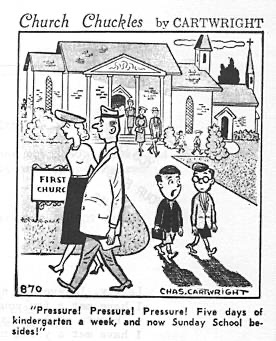
1. I have the impression that on the whole our churches have given little attention to the NATURE AND PURPOSE OF THE SUNDAY SCHOOL. In all our churches we do have such an institution, but it is a matter of tradition rather than of conscious choice. All other churches have a Sunday school, so we must have one too. It is simply part of the equipment of a church.
But what is a Sunday school? What is its primary aim? Is it primarily meant for instruction, i.e., to increase the Bible knowledge of our children? Or is it primarily evangelistic? But why then do we not try to get more children from unchurched families enrolled? Is it primarily a matter of character building? What are we really aiming at?
I believe that it would be very wholesome, if Sunday school teachers and the members of session came together and had an open and frank discussion on this matter.
It is of little use to carry on with our Sunday schools, if it is only a matter of tradition. This programme must have a clear-cut and definite aim, for otherwise it is a sheer waste of time.
2. In many Sunday schools in our churches TEACHERS are the weak spot. Please,understand me well. I deeply respect the love and zeal of all the men and women in our churches who every Sunday (or Saturday) give their time and energy for this work. In many cases they do a marvellous job within the limitations of the present system.
Yet the question must be asked: Are they really and properly equipped? Did they ever receive any training for this job? In most cases the answer is negative, and I am afraid that the greater part of the blame has to be put on the sessions and the ministers. Sessions simply appoint teachers and then expect them to make a good job of it. I know, they are often careful in their choice, but still the fact remains that they expect unexperienced people to do this important work. The attitude of the ministers is often the same. Although they are the spiritual leaders of the congregation, they neglect to give any leadership to the men and women who have been appointed as teachers in the Sunday school of the congregation. In some cases they never visit the Sunday school and have not the slightest idea of what is going on in this important department of their church’s life.
I am sure that it would be a tremendous help, both educationally and psychologically, if our ministers would meet with the teachers of the Sunday school (and with leaders of other youth work as well!) in order to discuss their work. Perhaps the session should ask the minister to give a training course for its Sunday school teachers and other youth leaders.
If this could be done, say, every two or three years, the standard of teaching would be lifted considerably. Another possibility would be to discuss this matter on the classical level. Perhaps the classis could ask one of its ministers, who has special abilities in this direction, to concentrate on this matter and give courses in the various churches of the classis.
3. Another important matter is the CURRICULUM. In many of our Sunday schools we use material from other churches , such as the Chr. Ref. Church or the Orth. Presb. Church. In many respects this is excellent material. But is it really suitable for us in our situation? Has it been thoroughly checked on this point by the minister and the Sunday school superintendent? Further, are the teachers acquainted with the whole ‘year plan’ underlying the lessons, or are they just moving from the one week into the other? Again I have to point to the minister who should give leadership in this vital area. He should call the teachers together and they should discuss it thoroughly so that the curriculum is not a kind of Abrahamic adventure but every teacher knows where he (or she) is going.
Another point of great importance for a sound curriculum is the question whether perhaps the whole method is too individualistic and moralistic. We are living in a time of great social issues and I believe that we must teach our children at a young age that a Christian should, in a Christian way, be involved in these issues. Christianity is more than a personal relationship between the individual and his God. There is also the parable of the good Samaritan! In our age with its race tensions, its wars, its poverty, its many lonely people, etc., our children should be told that the Gospel of Jesus Christ has an answer to these problems.
4. Finally, there are the PARENTS of the children, If a Sunday school programme is to be effective, it has to be closely linked to the life of the family.
We should deeply study the question how the parents of our children can be involved. Let us face the facts: in many cases they do not even know the names of the teachers! Perhaps they see the pamphlets now and then, but that is virtually all. But how can the Sunday school be effective, if the home is not squarely behind it? It would greatly help, I believe, if teachers would contact the parents, when they see that a child has problems. These problems can show themselves in many ways, for instance, by unruliness, lack of interest, etc. In such a case the teachers should see the parents and discuss the matter with them. But it cannot all come from the side of the teachers. The parents themselves should show interest. Perhaps it could be arranged that once in a while they attend the classes and thus get to know what is going on in the Sunday school.
I realise that I have mentioned more problems than solutions. To a large extent this is due to the fact that this whole area is rather unfamiliar for me too. But I do hope that there are some people in our churches who are willing to study these problems in order to help us all. In fact, the whole educational programme of the church (including the catechism classes) needs much more reflection. In the realm of school education much study is being done and many experiments are tried out.
It is about time that as a church we begin to realise that we may no longer neglect this area. On all levels of our church life we should give our attention to it: on the local, the classical (presbytery) and the synodical level. We should also realise that there are no panaceas or short-cuts. The only way ahead is that of solid and hard work.
K. RUNIA
 T&S Revisited