Rev A. Barkley, BA, “Trowel and Sword,” October 1954.
Preamble
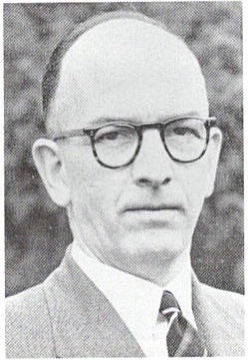
Alexander Barkley and his wife Elsie came to Australia in 1947 to serve the Reformed Presbyterian Church in Geelong as its minister. He developed a close working relationship with the Dutch migrants coming to this part of the country in the early 50’s and shared their vision of establishing a college for the training of ministers in Australia. He was the first lecturer appointed to the fledgling Reformed Theological College and was given the task of teaching Hebrew, Old Testament Exegesis, Church History and Pastoral Theology, as well as Apologetics which was to be shared with a second lecturer. From 1957 he was appointed Principle and remained in that position until his retirement in 1978. But Church History was his greatest love. For three years I sat in his lectures, spellbound, as he made history come alive. Who better to write an article extolling the value of Church History?
The Value of Church History
Before delving into the past to examine afresh some of the great events in the history of the Christian Church, it might be profitable to preface such a study with a consideration of the question, What is the value of such history? Some might be inclined to form a hasty conclusion that it has practically no value. They argue that we are living in the present and have to face the future, so why be concerned about the past? They are quite content to let “the dead past bury its dead” and live in ignorance of those happenings that have left such a mark upon generations of human beings. Needless to say we do not agree with any such view of history.
Others may not be so contemptuous of the record of past events, but they are content to abide in ignorance of them. They might know a few important dates, but otherwise they are void of any detailed knowledge. That unfortunately applies to the majority of professing Christians. They are not prepared to read the history of the Christian Church, nor become acquainted with the gigantic struggle for the preservation of the truth. They regard it as a rather dry morsel to be digested by a few who have a special delight in being old fashioned. For them life in this modern age is so much different, that the study of the past is regarded as a wast of time.
Before attempting to assess the value of a study of history, it is essential to define what we mean by history. If we regard it as the mere record of events, whether national, international or ecclesiastical it can be very uninteresting and dull. Such is not the view of history that should prevail in Reformed circles. The true Christian must regard history as the record of the unfolding of the plan that God, in His wisdom, has formulated for the world. In the Scriptures we can see how God raised up the ancient empires and cast them down according to His will in the fulfilment of His purpose. What is true in that age is no less true today. When we see in history the working out of the plan of our Sovereign and Covenant God, then history becomes a study that moves the soul. As Calvinists “We believe that the same good God, after He had created all things, did not forsake them nor give them up to fortune or chance, but that He rules and governs them according to His holy will, so that nothing happens in this world without His appointment.” (Belgic Confession, Art. xiii.). Dr. W. Hendriksen, in his excellent commentary on the book of Revelation shows how the true philosophy of history is theocentric. “The real mind,” he writes, “the real will which – while fully maintaining the responsibility of the individual instruments – controls this universe is the mind, the will of the Almighty God. Nothing is excluded from His dominion.” This is the view of history that we invite readers to accept.
To the person who believes in the Sovereignty of God, history is of inestimable value. For one thing it provides for him a more complete vision of the Majesty of God. The story of the rise and fall of empires reveals that human rulers, with all their pageantry and power cannot determine the destiny of nations. Secular historians may assign certain reasons for things that happen, but over all such there is the power of God. Some of these writers speak about “fate” or “chance” when something inexplicable happens, but to the Lord’s people it is another evidence of the wondrous works of God. They can sing with the Psalmist “The works of the Lord are great, sought out of all them that have pleasure therein.” It is therefore a healthy exercise for the soul to contemplate God in this fashion, rather than look upon events from a mere humanist viewpoint.
In contrast to this impression the record of events presses upon the reader the fact of sin and the depravity of the human heart. Dr. James Daane, writing in the Calvin forum, asserts that any true philosophy of history must begin with the Fall of man. How any person could read about the deeds that have been committed and then talk about all men being children of God and capable of saving themselves is an insoluble problem. It is remarkable that some of the most infamous of human deeds have found a prominent place in history while some of the more noble activities have scarcely been mentioned. We may glory in our victories in war and struggle with the problems that inevitably follow, but the real cause is to be found in the depravity of the human heart. The need for the message of the Gospel is all the more urgent in the light of history.
The value of Church history is also enhanced by the recognition of the fact, that God is ordering events in the interest of the Church. That principle is clearly demonstrated in scripture. In the midst of the conflicts between great empires we see the care God exercises over the little remnant of His chosen Israel. Our Lord pointed out that “for the elect’s sake’ certain days would be shortened, indicating the restraining power of God in events later recorded in history. Those who study Dr. Hendriksen’s book “More Than Conquerors” will derive no small measure of comfort from the fact that, in the book of Revelation we can see how God controls affairs in the interest of His Church. From the human level the Church is despised in the world, but not so in God’s sight. Whatever may happen in the conflicts between the nations, the Lord’s people can rest assured that final victory will not reside in the forces of evil.
Someone has said that a knowledge of the past is necessary to understand the present. The history of the Church throws a welcome light upon the problems that confront us today. Error has not changed with the passing of the centuries. The name may change but the nature of the heresy is very similar to its historical counterpart. God has been pleased to raise up leaders in the midst of His people to contend earnestly for the faith revealed in the Word of God. In the early centuries there was the conflict between Calvinism and Arminian teaching (which) led to the important Synod of Dort in 1618, which has given to the Reformed Churches the valuable articles known as the Canons of Dort. The doctrines of both Arius and Arminius are widespread in Protestant circles at the present time. The experience of the Church in the past should be a warning to us in these days when so many plead for tolerance. Our forefathers did not tolerate false teaching in their midst and their actions should be a challenge to us. Many of the ancient heresies nestle in the bosom of Modernism that has wormed its way into so many churches. Instead of the doctrines set forth in the historic confessions there is a substitute in the form of a social gospel, with its emphasis on human effort. There is still the old enemy of Romanism endeavouring to secure control and claiming to be the one true church. Multitudes are also marching under the banner of atheistic communism with its emphasis on the material. Our forefathers used the Sword of the Spirit, which is the Word of God, as the chief weapon, and like them we must learn to use the same.
The knowledge of God’s faithfulness in the past should be a constant source of encouragement to every loyal servant of Christ. We are in splendid company, and as we read about the heroic deeds of those who were prepared to face death, rather than prove disloyal to the Lord, the words of Hebrews 12:1 assume a new significance. “Wherefore seeing we also are compassed about with so great a cloud of witnesses, let us lay aside every weight, and the sin which doth easily beset us, and let us run with patience the race that is set before us, looking unto Jesus the author and finisher of our faith.”
Postscript
Prof. Barkley beautifully sums up one of the main reasons we started T&S Revisited. History in general is seldom taught in schools anymore leaving the vast majority ignorant of the past. As a result, what we often see now is a rewriting of history by activists and others to support a particular narrative that they are pushing. As Prof. Barkley points out, Christian Churches are not immune from this phenomenon and our best defence is to be well informed, particularly on the contents of scripture.
If you are of like mind, please “like” the article, forward the link to all and sundry and if you haven’t already done so, please subscribe to “tsrevisited.com” to receive all future articles which are sent weekly. Pieter and I would also be pleased to receive any comments or discussion points you care to raise about this or any other article previously posted.
 T&S Revisited